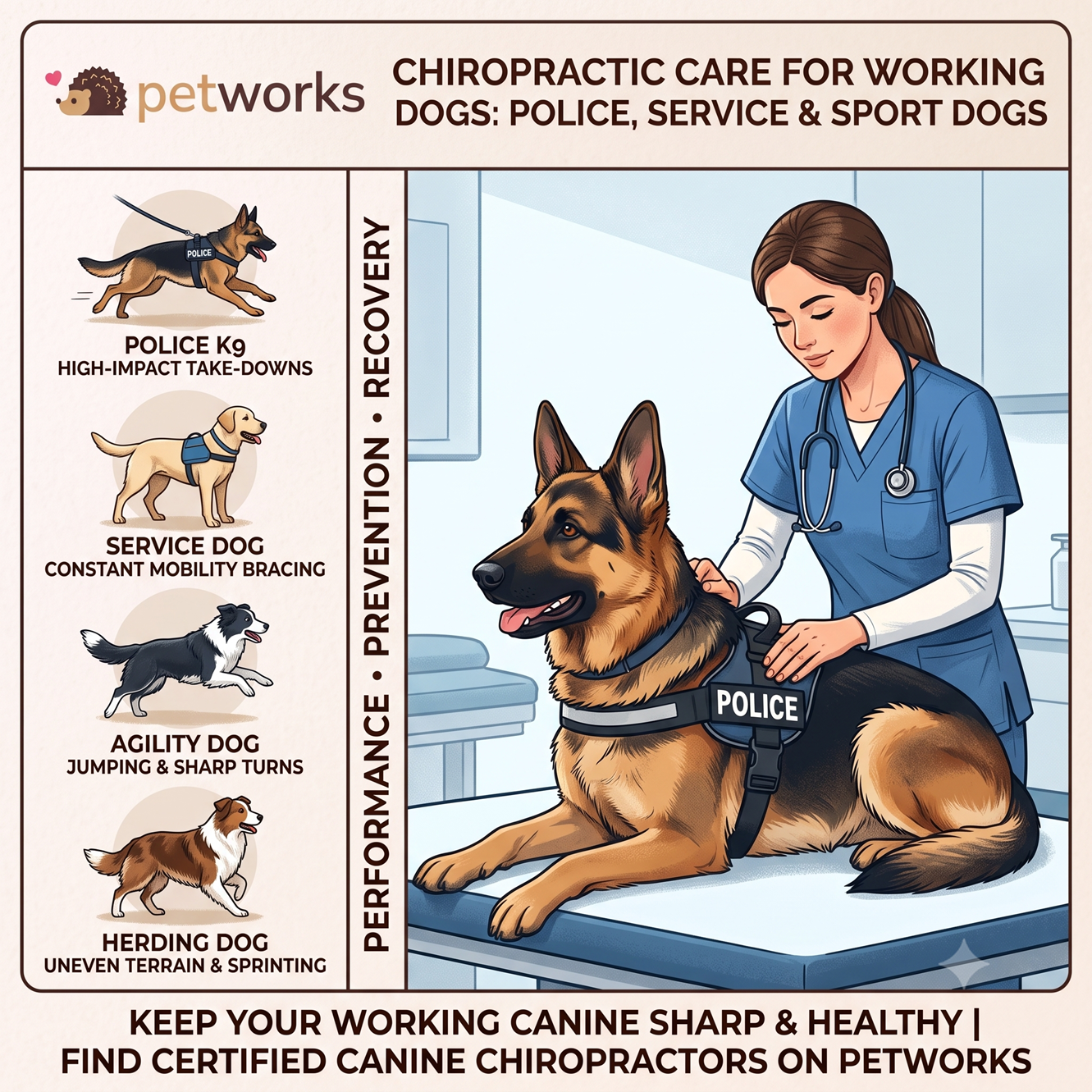
Working dogs have real jobs. Police K9s. Service dogs. Herding dogs. Agility and dock diving competitors. These aren’t couch companions. They’re canine athletes, and their bodies take a beating most house pets never experience. That’s why chiropractic care deserves a closer look for working dogs. It’s one of the most overlooked tools for keeping these dogs sharp, healthy, and on the job longer.
Why Working Dogs Are at Higher Risk
Working dogs tend to push through pain because their drive to perform overrides their instinct to protect themselves. A police K9 chasing a suspect isn’t thinking about his shoulder. A service dog bracing for a mobility task isn’t thinking about her spine. An agility dog launching over a jump isn’t thinking about his hips.
That stoicism creates a problem. By the time a limp, a shortened stride, or hesitation before a jump shows up, the underlying issue has usually been building for weeks.
Several factors put working dogs at elevated risk:
- Repetitive high-impact movement (jumping, sprinting, sudden turns)
- Bite work and takedown training for police and protection dogs
- Constant bracing and counterbalance work for mobility service dogs
- Awkward positioning during long stays or alerts for medical alert dogs
- Herding dogs cutting hard on uneven terrain
Types of Working Dogs That May Benefit from Chiropractic Care
Not every working dog performs the same type of physical work, but nearly all can experience repetitive stress on the muscles, joints, and spine. Chiropractic care may benefit dogs whose jobs require strength, endurance, agility, or repetitive movements, including:
- Law enforcement and military dogs, such as police K9s and military working dogs that perform tracking, detection, patrol, and apprehension work.
- Service and assistance dogs, including guide dogs, mobility assistance dogs, hearing dogs, and medical alert dogs that perform repetitive daily tasks for their handlers.
- Search and rescue and detection dogs, which often navigate challenging terrain while covering long distances during searches.
- Herding and livestock dogs, whose constant sprinting, sharp turns, and quick directional changes place significant stress on the spine and joints.
- Hunting and sporting dogs, which regularly run, jump, swim, and retrieve over uneven ground.
- Canine athletes, including dogs competing in agility, flyball, dock diving, disc, obedience, rally, and other performance sports.
Because every working role places different demands on a dog’s body, chiropractic evaluations should always consider the dog’s specific job, training schedule, and activity level.
How Chiropractic Adjustments Help Working Dogs Specifically
Chiropractic care for working dogs comes down to three things: performance, prevention, and recovery.
Performance. A dog with a properly aligned spine has better proprioception. That means the dog knows exactly where his feet are, which matters enormously during obstacle work, bite work, or a fast direction change. Handlers of agility dogs often report tighter turns and better weave pole timing after a few sessions.
Prevention. When one part of the spine gets restricted, the dog shifts weight elsewhere to compensate. Over time, that creates strain in the shoulders, hips, and knees that had nothing to do with the original problem. Regular adjustments catch this shift before it becomes an injury.
Recovery. Working dogs get hurt. When they do, canine chiropractic care can complement veterinary rehab by reducing pain, easing muscle guarding, and helping a dog return to full function faster.
Signs a Working Dog May Need an Evaluation
Pet parents and handlers should consider an evaluation if a working or sport dog shows any of these:
- A drop in performance that doesn’t match effort or training
- Reluctance to take a jump, obstacle, or command he normally handles well
- Uneven wear on paw pads or nails, which often points to gait compensation
- Stiffness after a shift, training session, or competition
- A subtle behavior change, like irritability during handling or grooming
What an Evaluation Looks Like
A certified canine chiropractor with experience in working and sport dogs is the right fit here. Look for certification through the American Veterinary Chiropractic Association, the organization that sets training and certification standards for this field. The evaluation typically involves palpating the spine, hips, and limbs to find areas of restricted motion. Adjustments themselves are gentle. There’s rarely any cracking or popping involved, and most working dogs tolerate the process well.
This isn’t a replacement for veterinary care. A vet should stay in the loop, especially for a dog actively in service or competition.
When Chiropractic Care May Not Be Appropriate
Although chiropractic care can play an important role in maintaining mobility and supporting recovery, it isn’t appropriate for every condition. Dogs with suspected fractures, spinal instability, certain neurological disorders, bone infections, or cancers affecting the spine or joints should first be evaluated and treated by a veterinarian. In these situations, chiropractic adjustments may be delayed or avoided altogether.
Working dogs that suddenly refuse to bear weight, show signs of severe pain, experience paralysis, or develop other emergency symptoms should receive immediate veterinary attention. Once the underlying condition has been diagnosed and stabilized, a veterinarian may recommend chiropractic care as part of a broader rehabilitation or long-term wellness plan.
Frequently Asked Questions
Can chiropractic care improve a working dog’s performance?
Yes. Many working and sport dogs show improved coordination, balance, and recovery time with regular adjustments, especially agility dogs and police K9s.
Is chiropractic care safe for service dogs?
Yes, when performed by a certified professional in coordination with the dog’s veterinarian.
How often should a working dog see a chiropractor?
This depends on workload and job type. A proactive, regular schedule tends to produce better outcomes than waiting for a visible problem.
Does chiropractic care replace physical therapy for an injured working dog?
No. It works best as a complement to veterinary rehab, not a substitute.
Find a Certified Dog Chiropractor
If a working or sport dog is showing signs of strain, reduced performance, or discomfort, the PetWorks nationwide pet care services marketplace connects pet parents with certified canine chiropractors.
About PetWorks
 In 2021, Dr. Marty Goldstein DVM joined the pet care platform PetWorks as an advisor in its Animal Nutrition care division. Dr Marty Nature’s Blend is on a mission to help your pets live their healthiest lives possible. Dr. Marty’s expertise in pet nutrition has helped PetWorks grow. His guidance has helped us become North America’s leading animal and pet nutrition consultation service for pet parents.
 In 2022, Blue Buffalo Founder Bill Bishop Jr. joined PetWorks as Senior Advisor in our Animal Nutrition Care Division. Bill brings his extensive expertise in pet food innovation and business leadership. His guidance helps PetWorks enhance our pet nutrition services. It also helps ensure that pet parents around the world receive trusted, science-backed nutritional support for their dogs, cats, and other animals.
About The Author
 PetWorks Co-Founder Kevin Kinyon is a life-long animal lover who works tirelessly to improve the lives of pets and their parents. Human and animal qualities he values most are integrity, humor, and empathy.

 petworks tm