If your cat has gone missing, the instinct to post on every neighborhood app and social media group immediately makes sense, but it’s usually the wrong first move. Cats and dogs behave differently when they go missing, so using dog search strategies for a lost cat often leads you to the wrong places. PetWorks is North America’s leading nationwide pet care services marketplace, and understanding how cats actually behave when lost is often the single biggest factor in a fast, successful reunion.
Here’s what the research on lost cat behavior actually shows, what to do in the first hours and days, and what kind of professional help is available if your own search isn’t turning anything up.
Quick Answer: Search your own home first, since cats often hide indoors undetected. Cats hide in silence rather than run when scared, so a quiet, physical search of your property and neighboring yards in the first hours matters more than posting online. Most lost cats are found within a few houses of where they disappeared. If your own search stalls, local lost pet finders, nationwide phone or video consultations, and pet psychics are all options PetWorks pet parents use, depending on the kind of support they’re looking for.
Cats Don’t Run. They Hide.
Dogs that get loose often run, sometimes for miles, driven by fear or the chase of something interesting. Cats behave almost the opposite way. Research from the Missing Animal Response Network, which has studied thousands of lost cat cases, found that most cats display what’s known as the silence factor: when a cat is frightened or displaced into unfamiliar territory, its instinct is to find the nearest hiding spot and stay completely silent, even when its owner is calling for it nearby.
This isn’t stubbornness or a cat “hiding out of spite.” Silence is a cat’s primary defense against predators, and it kicks in exactly when a cat is most scared and most in need of being found.
Most Lost Cats Are Closer Than You Think
Studies on lost cat recovery consistently show that most lost cats stay within a very short distance of where they went missing, often within just a few houses. Even confident, outgoing cats usually hide when they’re frightened, as the instinct to seek shelter overrides their normal personality once they panic in unfamiliar territory.
This is why an aggressive, physical search of the immediate area, your own property, neighboring yards, under decks and porches, dense bushes, matters so much more in the first days than posting online. By the time a social media post reaches people a mile away, your cat is very likely still within a few hundred feet of home.
First Steps If Your Cat Goes Missing
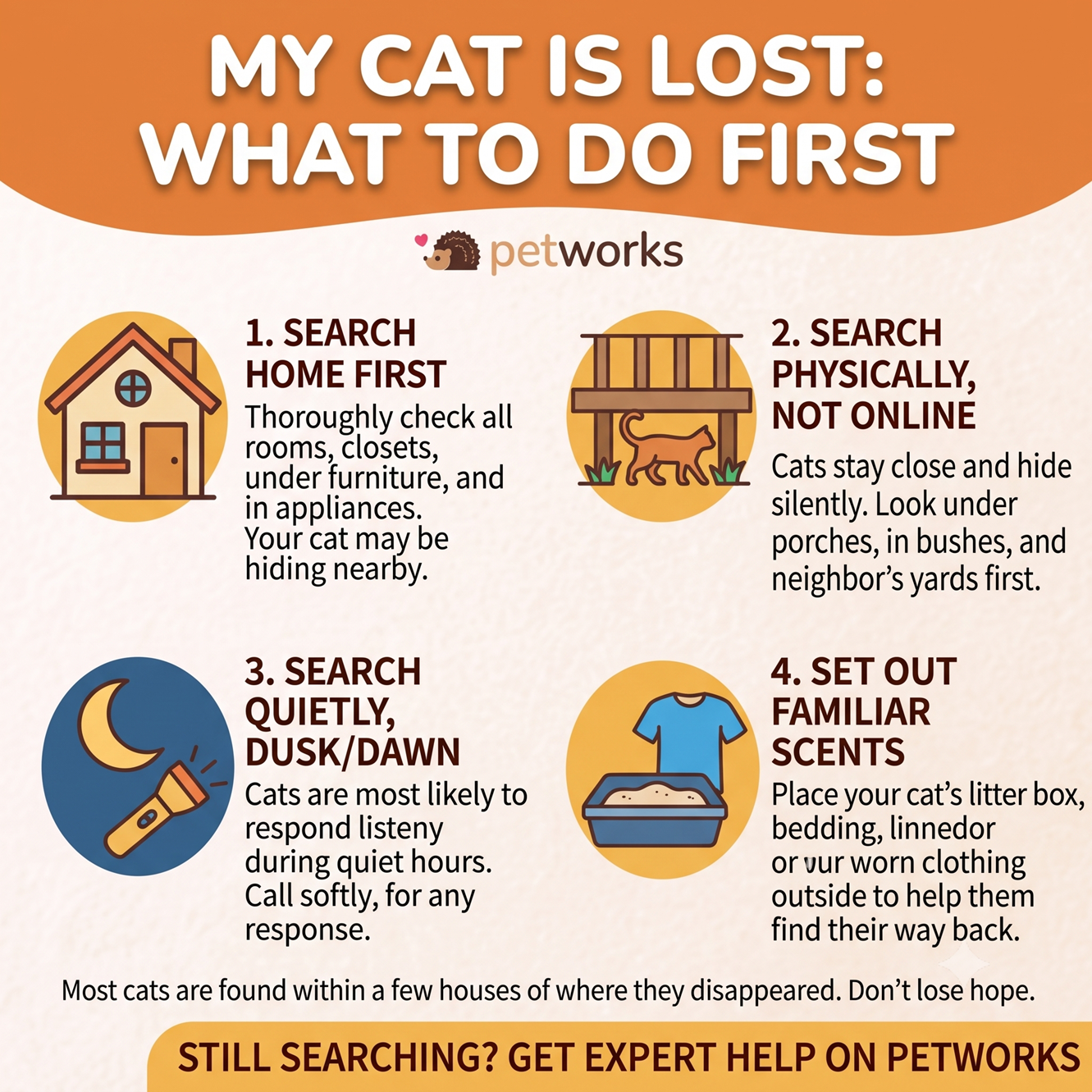
Search your own home thoroughly first. Cats are notorious for hiding in overlooked spots, closets, under beds, inside box springs, even behind appliances, and pet parents sometimes search the entire neighborhood before realizing their cat never left the house.
Search physically before posting online. Check under your own deck or porch, then knock on neighbors’ doors and ask permission to search their yards, sheds, garages, and under their decks too. Bring a flashlight for looking into dark, enclosed spaces, even during the day.
Search quietly and patiently, ideally at dawn, dusk, or night. Cats are more likely to respond, or at least to move slightly and reveal their location, during quieter hours when there’s less foot traffic and noise. Call your cat’s name softly and pause to listen for any response, rather than calling loudly and continuously.
Set out familiar scents near the escape point. Your cat’s bedding, a worn t-shirt, or their litter box placed near where they went missing can help draw them back toward a familiar scent if they’re hiding nearby and starting to consider coming out.
Consider a humane trap if the cat is skittish or has been missing more than a day or two. Especially for a naturally shy or fearful cat, a baited humane trap placed near the escape point or a spotted hiding location is often more effective than trying to approach and grab a frightened cat directly.
Lost Cat Search Checklist
- Searched every room, closet, and low hiding spot inside the home
- Checked under decks, porches, and crawl spaces on your own property
- Gotten permission and searched neighboring yards, sheds, and garages
- Set out familiar-scented bedding or a litter box near the escape point
- Conducted at least one quiet search during dawn, dusk, or nighttime hours
- Posted clear, close-range flyers in the immediate area, not just online
- Considered a humane trap if the cat hasn’t surfaced after a day or two
- Reached out for professional help if the search hasn’t turned up results
Types of Professional Lost Pet Help Available
Not every lost cat situation calls for the same kind of support, and PetWorks connects pet parents with a few distinct types of help depending on the situation.
Local lost pet finders provide hands-on, in-person search assistance, physically searching your property and surrounding area, setting and monitoring humane traps, and in some cases working with scent-detection dogs trained specifically to track a missing pet’s trail. This is generally the most direct option when a cat has been missing for more than a day or two and a physical search hasn’t turned anything up.
Nationwide finders offering consultations provide remote guidance by phone or video, regardless of your location. These specialists can help you interpret sightings, develop a targeted flyer and social media strategy, prioritize search areas based on your cat’s temperament and the circumstances of the disappearance, and troubleshoot a stalled search. This option works well for pet parents who want expert direction but don’t have access to a local in-person specialist, or who want a second perspective alongside their own search efforts.
Nationwide pet psychics offer a different kind of support, providing intuitive impressions about a missing pet’s possible location, condition, or emotional state. Scientific research has not validated this approach the way it has validated behavioral search methods, and results vary. However, some pet parents find that it provides emotional comfort or an additional perspective to consider alongside a physical search, not as a replacement for one.
Many pet parents combine approaches: a physical search at home, a consultation for strategy, and additional support if the situation calls for it.
When to Bring in a Professional
Most pet parents find lost cats by conducting a diligent, quiet search of the immediate area. However, professional lost pet recovery specialists can make a meaningful difference when a cat has been missing for several days, the search area is large or difficult to access, or pet parents need help interpreting sightings, scat, or other physical evidence. Specialists trained in lost pet recovery, including those who work with scent-detection dogs, understand cat-specific search patterns that differ significantly from techniques used for dogs. Example of a top lost cat finder specialist on PetWorks!
What Not to Do
Avoid leaving food out in a wide-open, exposed area, since a scared cat is unlikely to approach it while still in hiding mode, and it may just attract wildlife instead. Skip loud, repeated calling or search parties with multiple people and flashlights sweeping through an area at once, since this can push a hiding cat deeper into concealment rather than drawing them out. And don’t wait too long to start a physical search under the assumption your cat will simply come home on their own. While some do, the silence factor means many cats need to be actively found rather than waited out.
Frequently Asked Questions
How far do cats typically travel when lost?
Studies consistently show that most lost cats remain very close to home, often within just a few houses, even when they’re normally confident and social. Displacement into unfamiliar territory tends to trigger hiding rather than travel.
Why isn’t my cat responding when I call for them?
This is likely the silence factor: a frightened cat’s instinct is to stay completely quiet to avoid detection by predators, even when they can hear their owner calling. It’s not a sign your cat doesn’t want to be found.
Should I post on social media right away?
It doesn’t hurt, but it shouldn’t be your first or only action. Physically search your property and neighboring yards immediately after your cat goes missing. Because most cats stay close to where they disappeared, this search is typically more effective than posting online.
How long can a cat survive while hiding and lost?
Cats can survive for a surprisingly long time in hiding, sometimes over a week, before hunger drives them to break cover. This is why a search shouldn’t be abandoned after just a day or two.
Is my indoor-only cat at more risk if they get outside?
Indoor-only cats that escape outdoors are especially likely to hide immediately in the nearest concealed spot, since the outdoor environment is completely unfamiliar to them. The search area is often smaller for these cats, but the hiding instinct tends to be even stronger.
What’s the difference between a local finder and a nationwide consultation?
A local finder physically comes to search your area, set traps, or bring a scent-detection dog. A nationwide consultation provides expert strategy and guidance remotely, useful for pet parents who want professional direction regardless of where they’re located.
Take Action And Don’t Lose Hope
Losing a cat is frightening, but understanding how cats actually behave when scared changes the entire search strategy, and it’s often the difference between a quick reunion and a prolonged search in the wrong direction. For a broader look at professional recovery methods, see our guide on how pet detectives find lost dogs and missing cats.
Still searching for your cat? Whether you need a lost pet finder, a nationwide consultation, or a pet psychic for additional support, find the right professional on PetWorks and get help today.
About The Author
 PetWorks Co-Founder Kevin Kinyon is a life-long animal lover who works tirelessly to improve the lives of pets and their parents. Human and animal qualities he values most are integrity, humor, and empathy.

 petworks tm