Feline obesity is the most common preventable disease in cats, and it tends to creep up quietly. A cat doesn’t go from lean to overweight overnight. It happens gradually, a little softer around the middle each year, until one day a pet parent realizes their cat looks noticeably different from the cat in photos from a few years back. PetWorks is a pet care services marketplace, and weight management is one of the most common reasons cat parents book a consultation with a certified cat nutritionist.
PetWorks is a nationwide pet care services marketplace, and weight management is one of the most common reasons cat parents book a consultation with a certified cat nutritionist on our platform. (If your cat is losing weight rather than gaining it, see our guide on why cats lose weight instead.)
The encouraging news is that feline weight gain is almost always manageable with the right approach, and understanding why it happens is the first step.
Why Cats Gain Weight
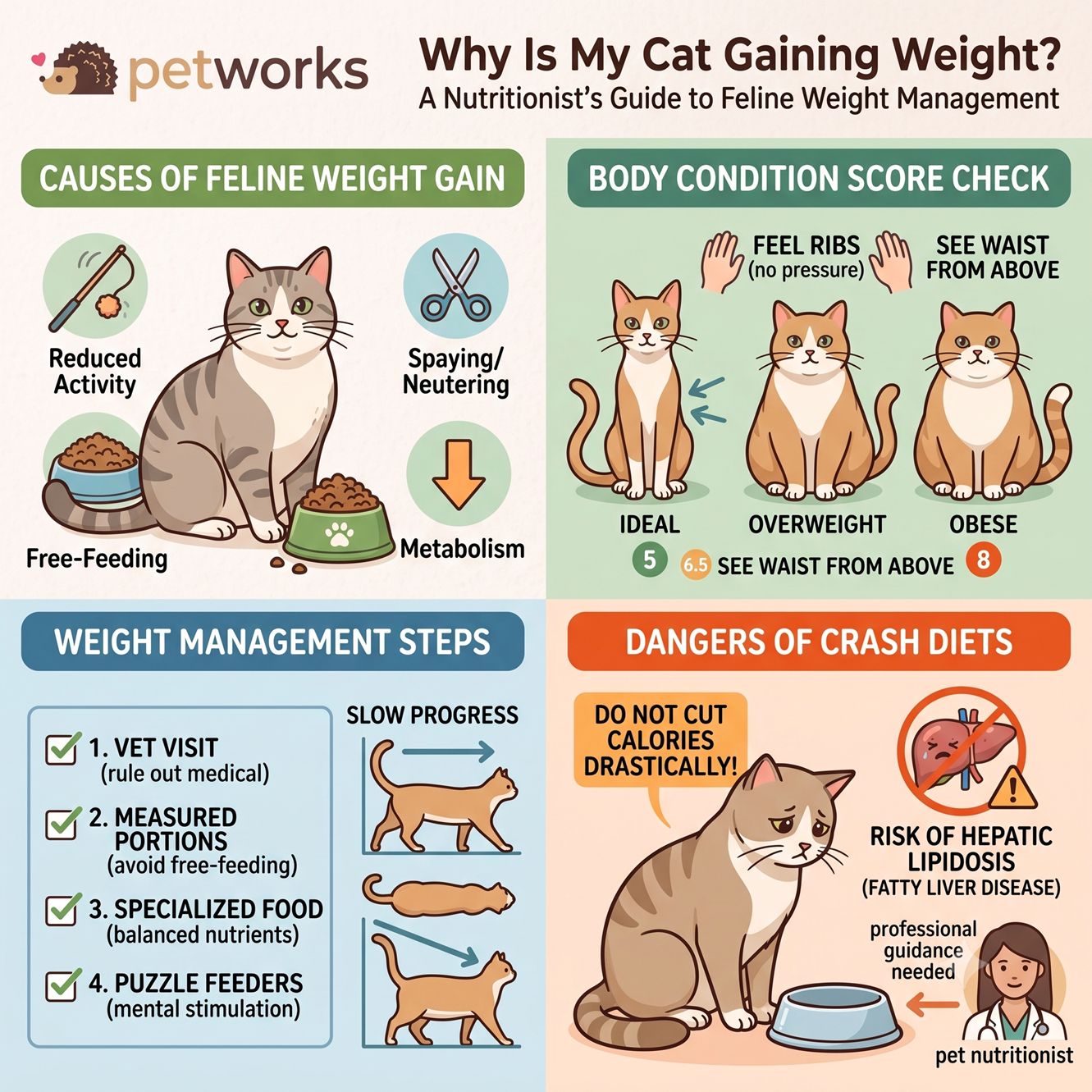
A handful of factors drive most feline weight gain. Reduced activity is a major one, especially for indoor-only cats without much environmental stimulation to encourage movement. Spaying and neutering lowers a cat’s metabolic rate and energy needs, which means many cats need less food after the procedure than pet parents realize. Free-feeding, leaving food out all day rather than portioning meals, makes it easy to overfeed without noticing, since most cats will eat more than they need if food is constantly available.
Age plays a role too, with middle-aged cats generally at the highest risk, since metabolism slows while feeding habits often stay the same. Less commonly, an underlying medical condition can drive weight gain, though weight loss is actually the more typical sign of most feline illnesses, so gradual weight gain in an otherwise healthy-seeming cat is usually more directly tied to calorie intake and activity level than disease.
How to Tell If Your Cat Is Overweight
Weight alone isn’t the clearest signal, since ideal weight varies by breed and frame size. Veterinarians typically use a body condition score instead, a hands-on assessment of how much fat covers the ribs, waist, and abdomen, scored on a scale of 1 to 9, where 5 is ideal. A cat scoring above 6 to 6.5 is generally considered overweight, and 8 or above is considered obese.
At home, a simple check: run your hands along your cat’s ribs. You should be able to feel them without significant pressure, similar to the feel of the back of your hand. If you have to press firmly to find them, or can’t feel them at all, your cat is likely carrying excess weight. Looking at your cat from above, a healthy cat typically shows a visible waist behind the ribs, rather than a straight or bulging silhouette.
Why Weight Management Matters
Excess weight in cats is linked to a meaningfully shortened lifespan and a higher risk of diabetes, osteoarthritis, and other chronic conditions. It’s also a condition that becomes harder to reverse the longer it goes unaddressed, which is part of why catching it early matters.
Why Crash Diets Are Dangerous for Cats
This is one of the most important things for cat parents to understand: unlike dogs or humans, cats cannot safely lose weight quickly. If a cat’s calorie intake drops too much, too fast, even for just a couple of days, their body can develop a serious and potentially fatal condition called hepatic lipidosis, or fatty liver disease. This is why simply cutting your cat’s portions in half is not a safe weight loss strategy, and why a structured, professionally guided plan matters more for cats than it does for most other pets.
What a Structured Weight Management Plan Looks Like
An effective feline weight loss plan is typically slow and controlled, often targeting a loss of around 1 to 2 percent of body weight per week. This usually involves a calorie-appropriate food specifically formulated for weight loss rather than simply less of the current food (see our complete guide to feeding your cat for more on choosing quality food generally), since weight-loss formulas are designed to maintain nutrient balance and satiety at a lower calorie density. Consistent, measured portions rather than free-feeding, along with strategies to increase activity, like puzzle feeders, wand toys, and vertical spaces to climb, round out most plans.
When to Bring in a Certified Cat Nutritionist
A veterinary visit is the right first step, both to rule out any medical contributor and to get an accurate weight and body condition assessment. From there, a certified cat nutritionist can build a specific, calorie-calculated feeding plan around your cat’s current weight, target weight, activity level, and food preferences, something generic feeding guidelines on packaging simply can’t account for.
This is especially valuable for cats that have already tried an unsuccessful diet, multi-cat households where portion control is complicated by shared feeding areas, or cats with a medical condition like diabetes where weight and diet need to be managed together carefully.
Frequently Asked Questions
How do I know if my cat is overweight or just naturally sturdy?
A body condition score assessment, checking how easily you can feel the ribs and whether a waist is visible from above, is more reliable than weight alone, since ideal weight varies by breed and frame. Your veterinarian can also assign an accurate score at a routine visit.
Is it safe to just feed my cat less to help them lose weight?
No. Cutting a cat’s food too quickly can lead to hepatic lipidosis, a serious and potentially fatal liver condition. Weight loss in cats needs to be gradual and structured, ideally with veterinary or nutritionist guidance.
Why did my cat gain weight after being spayed or neutered?
Spaying and neutering lowers a cat’s metabolic rate, meaning many cats need fewer calories afterward than they did before the procedure. If feeding amounts aren’t adjusted, gradual weight gain is common.
Can indoor cats avoid weight gain without a nutritionist’s help?
Some can, especially with portion control and enrichment to encourage activity. But cats that have already gained significant weight, or those in multi-cat households where feeding is hard to control, often benefit from a structured plan a nutritionist can provide.
How long does it typically take for a cat to reach a healthy weight?
It varies by how much weight needs to come off, but safe feline weight loss usually progresses at around 1 to 2 percent of body weight per week, meaning the process for a significantly overweight cat can take several months.
Sustainable Weight Management In Cats
Feline weight gain is common, but it isn’t something a cat can safely will away with a fad approach. It responds to a careful, structured plan built around how cats’ bodies actually work. Veterinarians and feline nutrition specialists like Dr. Marty Goldstein DVM, trusted by Oprah and Blue Buffalo Founder Bill Bishop Jr., have long emphasized that sustainable weight management in cats is about precision, not restriction.
Concerned about your cat’s weight? Find a certified cat nutritionist on PetWorks and build a safe, personalized weight management plan today.
About PetWorks
 In 2021, Dr. Marty Goldstein DVM joined the pet care platform PetWorks as an advisor in its Animal Nutrition care division. Dr Marty Nature’s Blend is on a mission to help your pets live their healthiest lives possible. Dr. Marty’s expertise in pet nutrition has helped PetWorks grow. His guidance has helped us become North America’s leading animal and pet nutrition consultation service for pet parents.
 In 2022, Blue Buffalo Founder Bill Bishop Jr. joined PetWorks as Senior Advisor in our Animal Nutrition Care Division. Bill brings his extensive expertise in pet food innovation and business leadership. His guidance helps PetWorks enhance our pet nutrition services. It also helps ensure that pet parents around the world receive trusted, science-backed nutritional support for their dogs, cats, and other animals.
About The Author
 PetWorks Co-Founder Kevin Kinyon is a life-long animal lover who works tirelessly to improve the lives of pets and their parents. Human and animal qualities he values most are integrity, humor, and empathy.

 petworks tm