When you’re planning a trip or need daytime care for your pet, three main options come up: in-home pet sitting, boarding, and daycare. Each works well for different situations, but they’re not interchangeable, and picking the wrong one can mean unnecessary stress for your pet. PetWorks is a nationwide pet care services marketplace, and helping pet parents understand these differences is one of the most common conversations we have, especially with pet parents choosing between options for the first time.
Here’s how the three actually compare, and why in-home pet sitting tends to be the preferred choice for the widest range of pets and situations.
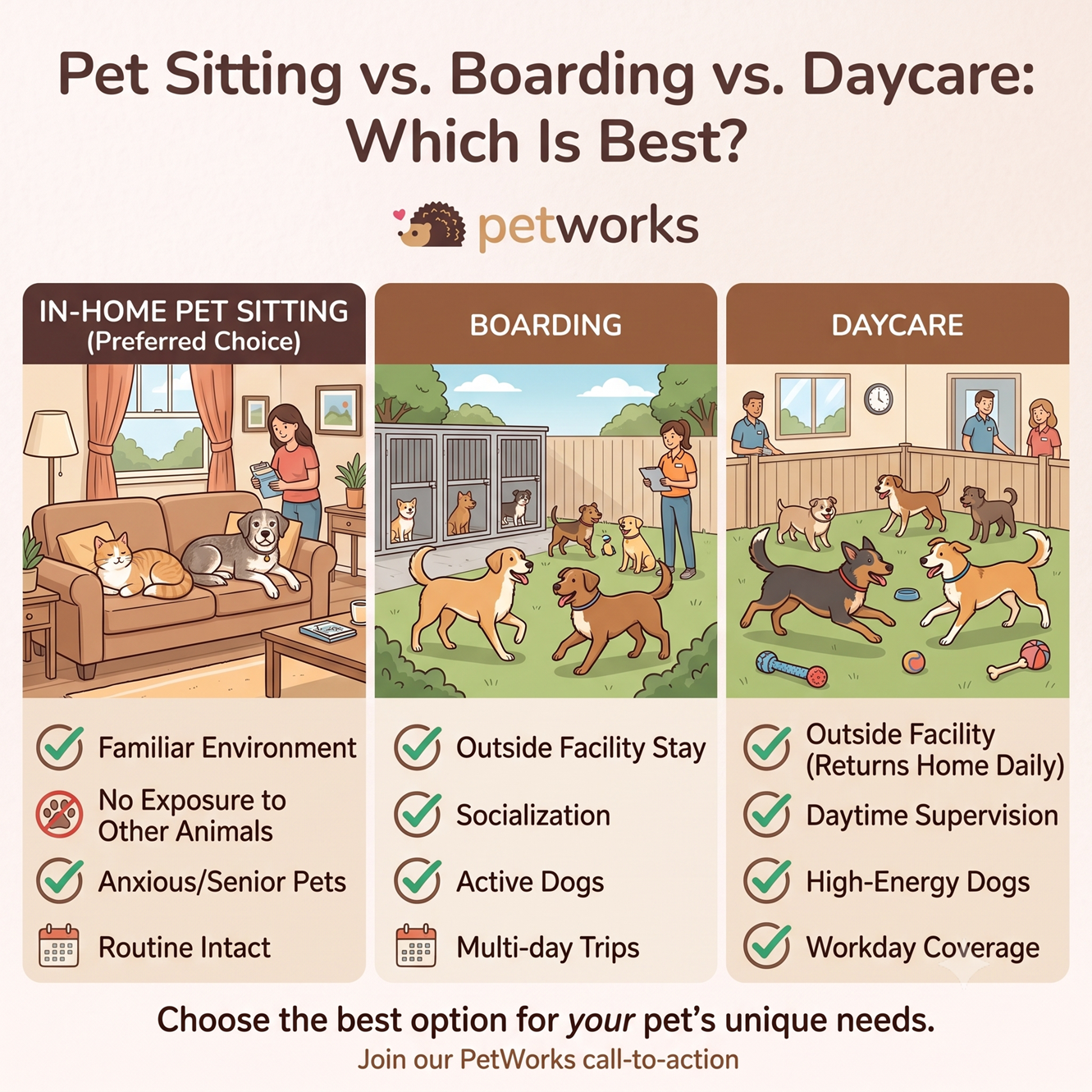
Quick Answer: In-home pet sitting keeps your pet in their own environment with no exposure to other animals, making it the best fit for anxious, senior, or routine-sensitive pets, and it’s the most commonly booked option among PetWorks pet parents. Boarding suits social, adaptable dogs on multi-day trips who enjoy other animals’ company. Daycare works well for active dogs needing daytime supervision while you’re at work. For most pets, in-home sitting offers the least disruption and the most personalized care.
The Core Difference: Where Your Pet Stays
In-home pet sitting means a sitter comes to your home and cares for your pet there, keeping them in their own familiar environment, on their own schedule, with their own bed, toys, and routine intact. Boarding means your pet stays overnight at a facility away from home, alongside other boarded animals. Daycare means your pet spends daytime hours at a facility with group play and supervision, then returns home each evening.
Why Environment Matters More Than Pet Parents Often Expect
Pets, especially cats and anxious or senior dogs, tend to find comfort in routine and familiar surroundings. A change in environment, even a well-run, comfortable one, is still a disruption that many pets experience as stressful. Research measuring stress hormone levels in dogs has found that unfamiliar kennel environments can produce a measurable physiological stress response, though individual dogs vary considerably, and some adapt or even seem to enjoy the change of scenery. In-home pet sitting avoids the variable of environment change entirely: no new smells, no unfamiliar sounds, no adjustment period, and no exposure to other animals your pet doesn’t know.
Comparing the Three Options
| Factor | In-Home Pet Sitting | Boarding | Daycare |
|---|---|---|---|
| Where pet stays | Your own home | Outside facility | Outside facility (returns home nightly) |
| Environment change | None | Full change | Partial, daytime only |
| Exposure to other animals | None (unless requested) | Yes, ongoing | Yes, during the day |
| Best suited for | Anxious, senior, or routine-sensitive pets | Multi-day trips, social dogs | Working pet parents needing daytime coverage |
| Overnight care | Yes | Yes | No |
| One-on-one attention | Typically highest | Varies by facility | Group-based |
Which Option Is Right for My Pet?
- If your pet gets anxious around unfamiliar people, animals, or environments → in-home pet sitting
- If your pet is a senior with mobility issues or a strict routine → in-home pet sitting
- If you have a cat, who tends to be especially sensitive to territory changes → in-home pet sitting
- If your pet takes daily medication and benefits from one-on-one attention → in-home pet sitting
- If your dog is highly social, adaptable, and you’re traveling for several days → boarding
- If your dog has high energy and thrives on group play during the workday → daycare
- If you want your home looked after too, mail, plants, a lived-in look → in-home pet sitting
When In-Home Pet Sitting Is the Clear Choice
In-home sitting tends to be the best fit for senior pets who don’t adjust well to new environments, anxious or easily stressed pets, cats, who are especially sensitive to territory and routine changes, pets on strict medication schedules that benefit from a caregiver focused on just them, multi-pet households where keeping pets together in their normal environment matters, and pet parents who want their home looked after too, mail collected, plants watered, a lived-in look maintained while they’re away.
What a Typical In-Home Pet Sitting Visit Looks Like
Most in-home visits follow a similar structure, though specifics vary by sitter and by your pet’s needs. A sitter arrives at the scheduled time and greets your pet in their familiar space, then handles feeding and fresh water according to your instructions. Walks or play sessions typically follow, giving your pet exercise and one-on-one attention. If your pet takes medication, the sitter administers it exactly as directed, and many sitters also handle basic home tasks like bringing in mail or rotating lights to maintain a lived-in look. Before leaving, most sitters send an update, a text, photo, or app notification, so you know your pet is happy and cared for, and note anything you should know before the next visit.
When Boarding or Daycare Might Make Sense Instead
Boarding can be a reasonable fit for social, adaptable dogs who enjoy the company of other animals, especially on trips where a facility offers activities and supervision a pet genuinely enjoys. Daycare can work well for working pet parents who need reliable daytime coverage and have an active, social dog that thrives on playtime and interaction with other dogs.
Even in these cases, many pet parents find that once they try in-home sitting, they prefer it, since it removes the guesswork of how their pet will handle a new environment entirely.
How to Transition from Boarding to In-Home Sitting
If you’ve only ever used boarding, switching to in-home sitting is easier than it might seem. Start by booking a short trial visit or two before your actual trip, so your pet and sitter can get comfortable with each other while you’re still home or nearby. Provide your sitter with a clear written routine, feeding times, walk schedule, favorite hiding spots or comfort items, so the experience feels as close to your own care as possible. Many pet parents find that once they see how calm their pet is during and after an in-home stay compared to a boarding stay, they don’t go back.
What to Ask Before Booking Any Option
Regardless of which type of care you’re considering, ask about staff-to-pet or sitter experience and certifications, emergency protocols and how quickly you’d be contacted if something came up, and what a typical visit or stay actually includes. For in-home sitting specifically, ask how many visits per day are included and whether overnight stays are available if you need them.
Frequently Asked Questions
Is in-home pet sitting more expensive than boarding?
Pricing varies by location and provider, but in-home sitting is often comparable to or more affordable than boarding, especially for multi-pet households, since many sitters charge per visit or per day regardless of how many pets are in the home.
Is in-home pet sitting safe if my pet is home alone between visits?
Reputable in-home sitters typically visit multiple times a day or offer overnight stays, and many pet parents combine this with pet cameras for added peace of mind. For pets who need more continuous supervision, ask your sitter about overnight or extended-stay options.
My dog has separation anxiety. Which option is best?
In-home sitting is generally the gentler option for dogs with separation anxiety, since it avoids the added stress of an unfamiliar environment on top of your absence. An overnight or extended in-home stay can provide even more consistency than visit-based care.
Can in-home sitters handle multiple pets or special medical needs?
Yes. Most in-home sitters are comfortable with multi-pet households and can administer medication, monitor specific health conditions, and follow a detailed care routine tailored to each pet.
Is daycare or boarding ever better for a pet’s wellbeing?
For very social, high-energy dogs who enjoy interacting with other animals, daycare or boarding can provide enrichment an in-home visit doesn’t. It depends on your individual pet’s temperament more than a one-size-fits-all answer.
There’s no universally “best” option among these three, but for the widest range of pets, especially anxious, senior, or routine-sensitive ones, in-home pet sitting tends to offer the least disruption and the most personalized care.
Ready to find a trusted in-home pet sitter near you? Browse vetted in-home pet sitters on PetWorks and book with confidence today.
About The Author
 PetWorks Co-Founder Kevin Kinyon is a life-long animal lover who works tirelessly to improve the lives of pets and their parents. Human and animal qualities he values most are integrity, humor, and empathy.

 petworks tm