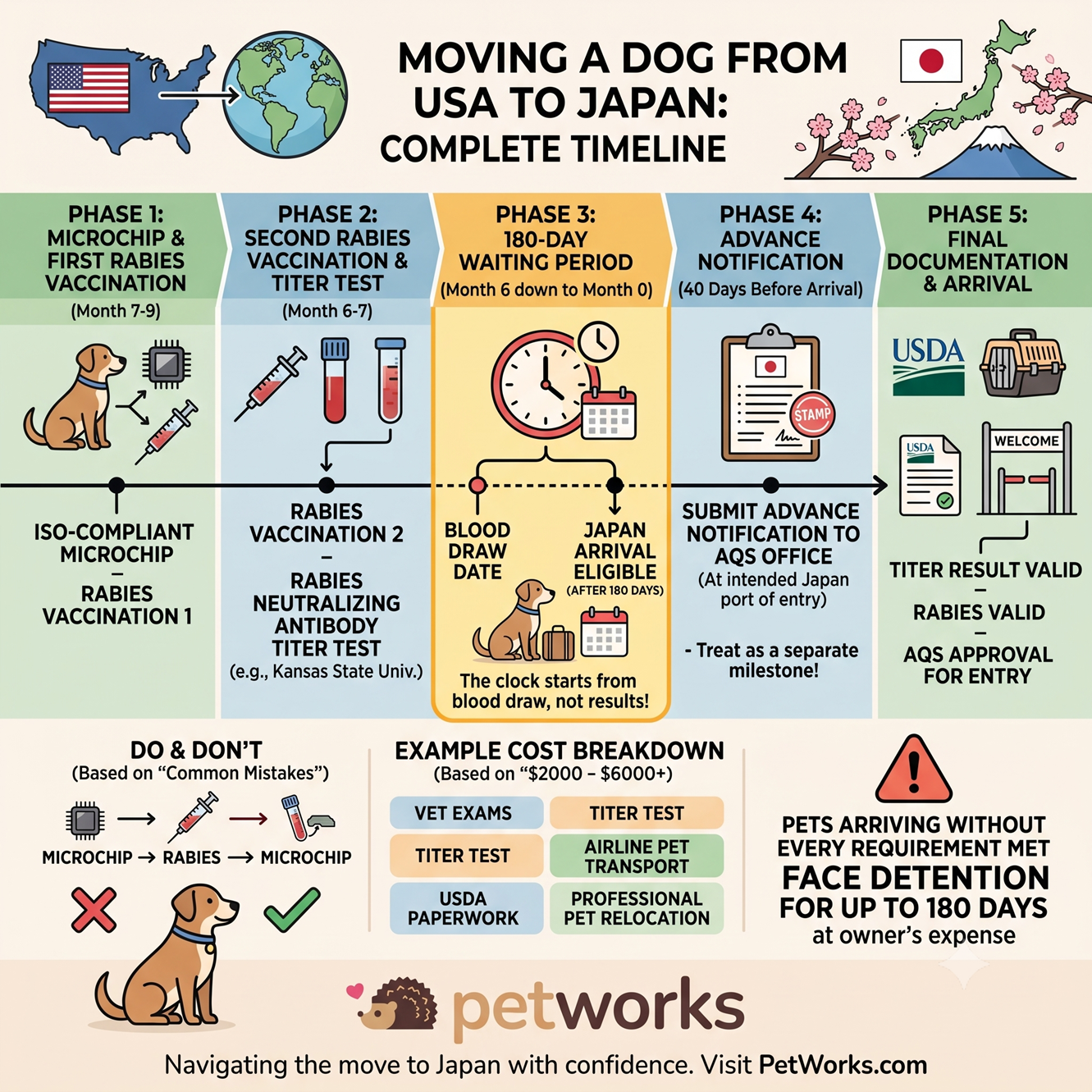
Moving a dog from the United States to Japan is one of the most tightly regulated pet relocations in the world, governed by Japan’s Animal Quarantine Service (AQS) under the Ministry of Agriculture, Forestry and Fisheries. Whether you’re relocating for work, returning home, or starting a new chapter in Japan, bringing your dog along requires a precise, months-long process that cannot be shortened no matter how quickly the rest of your move comes together.
Japan maintains rabies-free status, one shared by only a small number of countries worldwide, and its import rules exist specifically to protect that status. This guide walks through exactly what the process involves and why timing is the single most important factor.
Why the USA to Japan Route Requires Exact Timing
Unlike a domestic move, where a health certificate issued within a couple of weeks of travel is often enough, Japan bases its import process on a strict, non-negotiable waiting period that starts on the date of your dog’s rabies titer blood draw. Every other document, the microchip, the vaccinations, the advance notification, has to fall into place around that single date. Miss a step or get the order wrong, and the entire 180-day countdown can reset from scratch.
Pets arriving without every requirement met face detention at an Animal Quarantine Station for up to 180 days at the owner’s expense, which is why working with an experienced international pet shipping coordinator matters as much for this route as the paperwork itself. A pet transportation marketplace platform like PetWorks connects families with professionals who manage this exact process regularly, rather than leaving pet parents to interpret government forms on their own.
The Chronological USA to Japan Timeline
Most successful moves take seven to nine months from start to finish. Here’s how that time breaks down.
Phase 1: Microchip and First Rabies Vaccination (Month 7 to 9)
Start the process by having your dog implanted with an ISO-compliant microchip before you complete any other import requirements. After the microchip is in place, vaccinate your dog against rabies once your dog is at least 91 days old. If your dog received a rabies vaccination before the microchip was implanted, Japan will not recognize that vaccination. You’ll need to vaccinate your dog again after the microchip is implanted to meet Japan’s import requirements.
Phase 2: Second Rabies Vaccination and Titer Test (Month 6 to 7)
At least 30 days after the first vaccination, your dog needs a second rabies vaccination. Your veterinarian can draw your dog’s blood sample for the rabies neutralizing antibody titer test during the second vaccination appointment or at a later visit. You must send the sample to a laboratory that Japan officially recognizes, such as the Kansas State University Rabies Laboratory in the United States. The result must show an antibody level of at least 0.5 IU/mL to pass.
Phase 3: The 180-Day Waiting Period (Month 6 down to Month 0)
This is the step that catches the most pet parents off guard. The 180-day clock starts on the date your dog’s blood was drawn for the titer test, not the date the results come back, and not the vaccination date. Your dog cannot enter Japan until at least 180 days have passed from that blood draw. If your dog’s titer result falls below 0.5 IU/mL, your veterinarian must give a booster vaccination and collect a new blood sample. Japan will restart the 180-day waiting period from the date of the new blood draw.
Phase 4: Advance Notification (40 Days Before Arrival)
Separately from the 180-day wait, you must submit an advance notification to the AQS office at your intended Japanese port of entry at least 40 days before your dog arrives. You can submit the advance notification anytime during the 180-day waiting period after your dog has received a microchip, both rabies vaccinations, and a qualifying titer test. If you miss the 40-day deadline, Japan may deny or significantly delay your dog’s entry even if you’ve completed every other requirement. Treat this deadline as a separate milestone, not an afterthought.
Phase 5: Final Documentation and Arrival
Both your titer result (valid for two years from the blood draw) and your current rabies vaccination must still be valid on your dog’s arrival date. Once AQS reviews your advance notification, they issue an approval that you’ll need for airline check-in and arrival processing. If everything is in order, quarantine inspection on arrival typically takes as little as 12 hours rather than an extended stay.
A Note on Designated Rabies-Free Regions
Japan maintains a shorter process for pets coming from a small list of officially designated rabies-free or controlled regions, which currently includes places like the United Kingdom, Australia, New Zealand, Iceland, and notably, Hawaii. If your dog has spent extended time in one of these locations under the right conditions, a modified timeline may apply. Pets traveling from the U.S. mainland must follow the full import process because Japan does not include the mainland United States on its designated rabies-free region list.
Flight and Transport Considerations
Most international flights into Japan require pets to travel in the cargo hold or as checked baggage rather than in the passenger cabin, though this varies by airline, so confirm directly with your carrier well before booking. Given the complexity of this route, many pet parents work with an international pet shipping coordinator who can manage both the AQS paperwork and airline-specific requirements as a single coordinated process.
Frequently Asked Questions
How long does it actually take to move a dog from the USA to Japan?
Most moves take seven to nine months from the first vet appointment to arrival, accounting for the two vaccinations, the 30-day gap between them, the titer test, the mandatory 180-day wait, and the 40-day advance notification window.
What happens if my dog’s titer test fails?
If the antibody level comes back below 0.5 IU/mL, your dog needs a booster vaccination and a new blood draw. The 180-day waiting period restarts completely from the date of that new blood draw, which is why starting the process as early as possible matters.
Can I use a flight nanny to bring my dog into Japan?
Most international routes into Japan require dogs to travel as checked baggage or cargo rather than in-cabin, though specifics vary by airline. Confirm directly with your carrier, since this differs from domestic U.S. flight nanny arrangements.
What happens if my dog arrives before the 180 days are up?
Airport officials will place your dog in a quarantine facility for the remaining days needed to complete the full 180-day waiting period, and you’ll be responsible for all associated costs. Plan your dog’s arrival around the blood draw date, not just your own travel schedule, to avoid an extended quarantine stay.
Is the process different for cats?
No. Cats face the exact same requirements as dogs: microchip, two rabies vaccinations, a titer test with the same 0.5 IU/mL threshold, the 180-day wait, and the 40-day advance notification. There are no exceptions by species.
Japan Dog Import Checklist: Everything You Need Before Arrival
Before your dog can enter Japan from the United States, you must complete each of the following steps:
✅ ISO-compatible microchip implantation
✅ First rabies vaccination after microchipping
✅ Second rabies vaccination at least 30 days later
✅ Rabies neutralizing antibody titer test through an approved laboratory
✅ 180-day waiting period after the blood draw date
✅ Advance notification submitted to Japan’s Animal Quarantine Service at least 40 days before arrival
✅ USDA endorsement of required export documents
✅ Airline-approved travel crate and transportation arrangements
✅ Final veterinary health examination before departure
How Much Does It Cost to Move a Dog From the USA to Japan?
The cost to move a dog from the United States to Japan varies depending on your departure city, dog’s size, airline requirements, and whether you hire an international pet shipper. Most pet parents should expect to budget between $2,000 and $6,000 or more for a complete relocation.
Common expenses include:
- Veterinary exams and vaccinations: $200–$500+
- Rabies titer test: $100–$300+
- USDA endorsement fees and paperwork: varies
- Airline pet transport: $1,000–$3,000+
- Professional pet relocation assistance: $500–$2,000+
- Travel crate and supplies: $100–$500+
Common Mistakes That Can Delay Your Dog’s Arrival in Japan
Even small mistakes can create months of delays when importing a dog into Japan. The most common problems include:
Microchipping after rabies vaccination
Japan does not recognize rabies vaccinations given before the required microchip.Starting the titer test too late
The 180-day waiting period begins from the blood draw date, not when results arrive.Missing the 40-day advance notification deadline
A completed medical record does not replace the required AQS notification.Booking flights before confirming import approval
Airline requirements and arrival procedures should be confirmed before finalizing travel plans.
Japan’s import process is exacting, but it’s entirely manageable with the right timeline and the right professional support. Starting the process the moment international relocation becomes a possibility, rather than waiting for certainty on your move date, is what makes the difference between a smooth arrival and an unplanned quarantine stay.
Ready to navigate your dog’s move to Japan with confidence? Browse certified international pet shippers on PetWorks today to compare credentials and get a customized quote.
For official, up-to-date requirements, always check directly with Japan’s Animal Quarantine Service before beginning the process, since specific lab approvals and regional designations can change.
About The Author
 PetWorks Co-Founder Kevin Kinyon is a life-long animal lover who works tirelessly to improve the lives of pets and their parents. Human and animal qualities he values most are integrity, humor, and empathy.

 petworks tm