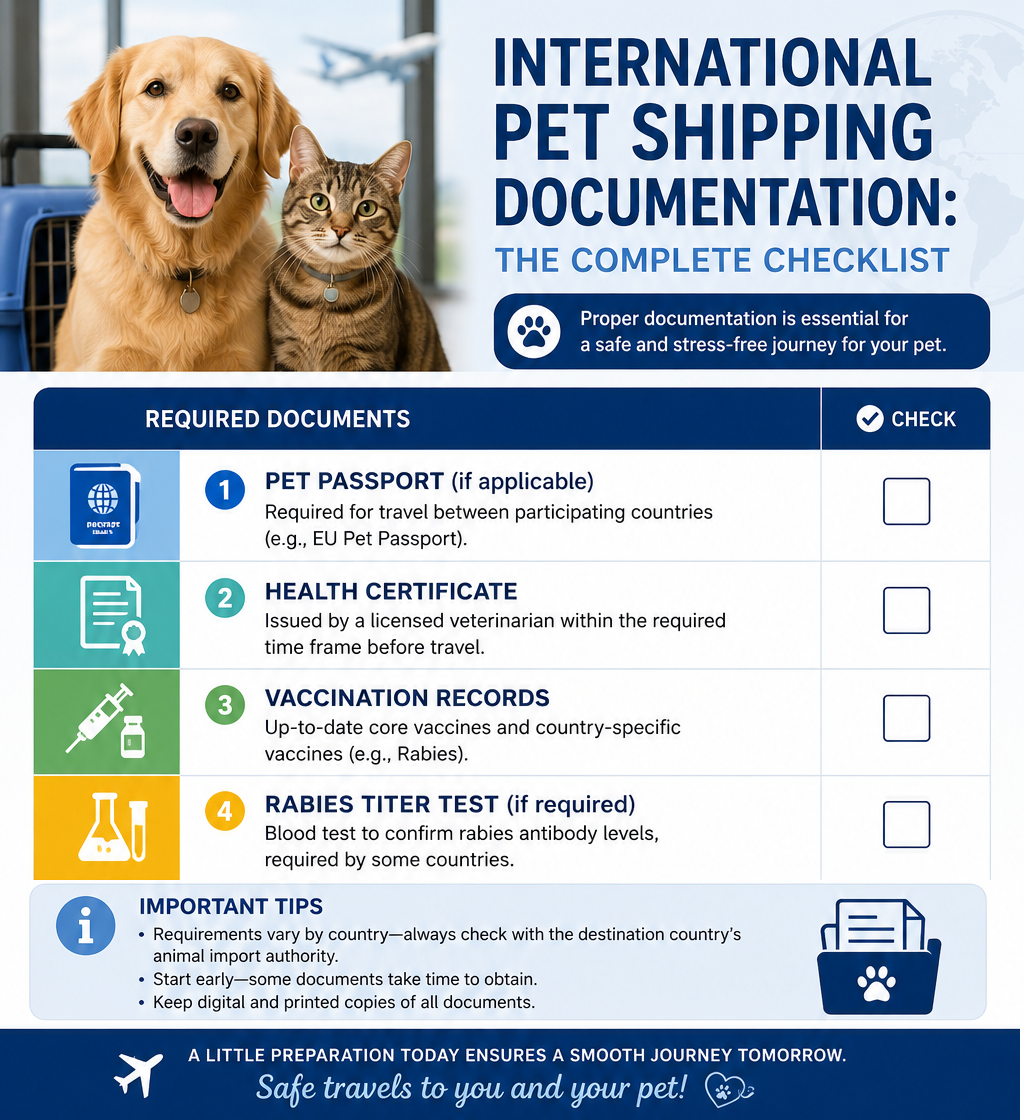
Shipping a pet internationally is one of the most logistically complex things a pet parent can do. The flights, the crates, the costs — those are the parts people tend to focus on. But the documentation is where international pet shipping most often goes wrong. A missed health certificate window, an unendorsed USDA form, a rabies titer test that was done six days too late — any one of these can result in your pet being held at the border, sent back to the origin country, or placed in quarantine at your expense. The paperwork is not a formality. It is the foundation of the entire process.
This checklist is designed to walk you through every major document category involved in international pet shipping, explain why each one matters, and help you understand what varies by destination so you can plan ahead and avoid the mistakes that derail even the most carefully planned moves.
Start Here: The Two Things That Determine Everything
Before you can build your documentation checklist, you need two pieces of information: where your pet is going, and what species and breed your pet is. Every other requirement flows from those two facts.
Different countries have radically different import rules. Australia requires a minimum of 180 days of preparation and mandatory post-arrival quarantine. Canada requires very little for most dogs and cats coming from the United States. The EU has a highly structured process with specific timing requirements. Japan has some of the most demanding protocols in the world.
Breed matters too. Brachycephalic breeds (dogs like French Bulldogs, Pugs, and Boston Terriers; cats like Persians and Himalayans) face restrictions with many airlines and may require additional veterinary sign-off before travel is approved.
Once you know those two things, the checklist below will make sense. Work through it from the top, and do not skip sections just because they seem unlikely to apply to you.
Core Documents Required for Almost Every International Shipment
1. USDA-Accredited Veterinary Health Certificate
A health certificate is the foundational document for international pet shipping from the United States. It must be issued by a veterinarian who is accredited by the USDA, and it must be issued within a specific window before your pet’s departure date. Most countries require the certificate to be issued within 10 days of arrival. Some, including EU member states, require it within 10 days of the date the pet enters the destination country, which can create a tight window if travel involves connections or layovers.
The health certificate confirms that your pet has been examined by a licensed veterinarian, appears healthy and fit for travel, is free from signs of infectious disease, and meets the vaccination requirements of the destination country.
Do not book your appointment too early. A health certificate issued on day one that expires before your pet lands is worthless.
2. USDA APHIS Endorsement
For most international destinations, a veterinarian-issued health certificate is not sufficient on its own. It also needs to be endorsed by the USDA Animal and Plant Health Inspection Service (APHIS). This endorsement confirms that the signing veterinarian is legitimately accredited and that the certificate is authentic.
USDA endorsement is handled through APHIS veterinary offices, and the process takes time. Some pet parents use the USDA eFile system, which allows accredited vets to submit certificates electronically for faster processing. Others mail the original documents, which can take several business days. Either way, this step needs to be built into your timeline before the health certificate expires.
If you are working with a professional international pet shipper, they will typically coordinate the APHIS endorsement process on your behalf.
3. Proof of Rabies Vaccination
Virtually every country in the world requires proof of current rabies vaccination for dogs, and most require it for cats as well. The vaccination must have been administered by a licensed veterinarian, and the documentation must include the date of vaccination, the vaccine brand and batch number, and the date the vaccination expires.
Timing is critical here for two reasons. First, some countries will not accept a rabies vaccination that was given fewer than 21 or 30 days before travel, because they want the vaccine to have taken effect before the animal arrives. Second, some countries require the rabies vaccination to have been given after the pet was microchipped — a detail that trips up a surprising number of pet parents who got the vaccine before reading the destination country requirements carefully.
4. ISO-Compliant Microchip
Most countries now require pets to be microchipped before entry, and the chip must comply with ISO Standard 11784 or 11785, which is a 15-digit chip format. The United States has historically used 9-digit or 10-digit chips in some cases, which do not meet the ISO standard.
If your pet has a non-ISO chip, you have two options: have a second ISO-compliant chip implanted (most vets will place it; the original chip stays in place), or bring a compatible scanner if the destination country allows it. Most do not allow the scanner workaround. Get the ISO chip.
The microchip must also be implanted before the rabies vaccination in countries that use vaccination timing as part of their entry calculation. If your pet was vaccinated before being chipped, some countries will require you to start the vaccination sequence over after microchipping.
Region-Specific Requirements
European Union
The EU operates under a harmonized system for pet travel, but the requirements are more detailed than many pet parents expect.
Dogs, cats, and ferrets entering an EU member state from the United States must have an ISO-compliant microchip. They must also have a current rabies vaccination that was administered after the microchip was implanted. In addition, pets must travel with a health certificate in the official EU format. Authorities do not accept just any health certificate. They require the official EU health certificate for entry from third countries. This form has specific fields and must be completed correctly.
Dogs entering certain EU member states (including Finland, Ireland, Malta, Norway, and the United Kingdom) must also have a documented tapeworm treatment administered by a veterinarian within a specific window before arrival — typically between 24 and 120 hours before entry. This is an easy requirement to overlook because it is so close to the departure date.
The health certificate must be issued within 10 days of arrival in the EU.
United Kingdom
The UK left the EU and now operates its own pet travel scheme, which is similar to but separate from the EU system. Dogs, cats, and ferrets require an Animal Health Certificate (AHC) issued by an Official Veterinarian (OV) within 10 days of travel. The UK does not accept the EU health certificate format; it requires its own AHC form.
Dogs also require tapeworm treatment within 24 to 120 hours before arrival, documented in the AHC. The UK is a rabies-free country and takes biosecurity seriously. Documentation errors are not handled informally at the border.

Are you finding this article useful? Would you like 100% free access to more articles like these, and free access to over 5,000 vetted pet care service professionals throughout the United States? Sign up here for a free PetWorks account, and we’ll email you a 10% discount code, good towards your first pet care services booking on PetWorks!
Australia and New Zealand
New Zealand and Australia have the most demanding pet import requirements in the world, and planning for either destination should begin at least six months before your intended travel date, and often longer.
Australia requires that pets arrive from an approved country or complete a period in an approved third country first. The United States is not on Australia’s approved country list, which means pets must spend time in an approved transitional country (such as the UK or Singapore) before entering Australia. The total preparation timeline, including the time in the transitional country, is a minimum of 180 days.
Upon arrival in Australia, all pets undergo mandatory quarantine at the government facility in Mickleham, Victoria. The quarantine period is a minimum of 10 days, and the cost is borne by the owner. It must be booked in advance, and spots are limited.
New Zealand has similarly strict protocols and also requires a minimum preparation period, government-approved quarantine, and documentation that must be prepared in a very specific sequence.
If you are moving a pet to Australia or New Zealand, working with a professional international pet shipper is not optional. The paperwork sequence is precise enough that most pet parents cannot navigate it successfully without expert guidance.
Japan
Japan requires one of the longest advance preparation windows in the world. The country requires a rabies antibody titer test — specifically the FAVN (Fluorescent Antibody Virus Neutralization) test — and the import date must be at least 180 days after the blood was drawn for that test. This 180-day clock cannot be shortened, and there are no exceptions.
In addition to the titer test timing, Japan requires two rabies vaccinations given within a specific interval, microchipping before the vaccinations, USDA-endorsed health certificate documentation at multiple stages of preparation, and a pre-arrival import notification submitted to Japan’s Animal Quarantine Service before departure.
Upon arrival, dogs and cats are inspected at the airport. If documentation is complete and correct, most pets are released within a day or two. If anything is wrong, pets can be held in quarantine at the owner’s expense for up to 180 days.
Canada
Canada is one of the simpler destinations for pet parents shipping from the United States, though “simpler” is relative.
Dogs require either a rabies vaccination certificate or, for dogs under three months of age that have not been vaccinated, a declaration that the dog is too young for vaccination. Dogs entering from the US do not currently require a health certificate unless they are commercial imports (arriving without their owner or being sold). Cats have no CFIA import requirements from the United States.
That said, airline requirements still apply regardless of government regulations, and most carriers require a health certificate for any pet traveling as cargo. Confirm what the specific airline requires in addition to federal regulations.
Mexico and Latin America
Mexico requires a health certificate issued by a licensed veterinarian within 10 days of travel and proof of current vaccination against rabies, distemper, hepatitis, pip, leptospirosis, and bordetella for dogs. Cats require vaccination against feline panleukopenia, rhinotracheitis, and rabies.
Requirements across Latin American countries vary significantly. Colombia, Peru, Chile, and Brazil each have their own import protocols, and several require an official government health certificate (not just a private vet’s letter) endorsed by the destination country’s consulate or the USDA. Always verify the specific requirements for your destination country at least eight weeks before travel.
The Rabies Titer Test: When You Need It and Why It Takes So Long
The rabies titer test — also called the FAVN test or RNAT test — measures the level of rabies antibodies in your pet’s blood. It is required by countries that want to verify not just that a pet was vaccinated, but that the vaccination actually produced an immune response.
Countries that require a titer test include Japan, Australia, New Zealand, Singapore, Hawaii (which has its own requirements as a US state), and several others. The EU does not currently require a titer test from US pets for general entry, though individual member states may have additional requirements.
The test must be done at a laboratory approved by the destination country. In the United States, Kansas State University’s Rabies Laboratory is the most commonly used for FAVN testing. Results typically take two to three weeks.
Most importantly: many countries start a countdown clock from the date the blood was drawn, not the date the test results came back. For Japan, that clock is 180 days. For Australia, the timing is part of a complex multi-step sequence. The titer test is not something you arrange a few weeks before departure. It is one of the first steps in planning.
CITES Permits: Exotic Species and Protected Breeds
If you are shipping an exotic pet, a bird, a reptile, or even certain dog or cat breeds that are derived from protected wild species, you may need a CITES permit. The Convention on International Trade in Endangered Species controls the movement of animals (and animal products) that are listed under its appendices.
African Grey parrots, macaws, certain tortoises, iguanas, and many other animals fall under CITES regulations. Some dog breeds with recent wild ancestry may also require documentation. If there is any possibility that your pet or its species falls under CITES, check with the U.S. Fish and Wildlife Service before making any travel plans.
CITES permits can take weeks or months to obtain and cannot be expedited. Starting this process late is one of the most common reasons exotic pet shipments fail entirely.
Airline-Specific Documentation Requirements
Government import documents get your pet into the country. Airline documents get your pet onto the plane. These are two separate sets of requirements, and both must be satisfied.
Most airlines require a health certificate issued within 10 days of travel (some require within 7 days). The health certificate must confirm that the pet is fit for air travel, not just fit for import.
Airlines also require IATA-compliant crates with specific dimensions, ventilation, and fastening requirements. The crate must be large enough for the pet to stand, turn around, and lie down comfortably. Airlines verify crate compliance at check-in, and pets in non-compliant crates are not loaded.
Many airlines have restrictions on brachycephalic breeds, particularly in cargo. Some have banned them from cargo entirely. Some have temperature restrictions that limit when pets can travel by season or route. If your pet is a snub-nosed breed, or if your travel dates fall in summer, verify with the specific airline before booking anything.
Airlines limit the number of pets allowed per flight, and these spots book out. Confirm your pet’s reservation at the time you book your own ticket, not afterward.
A Timeline for Getting Documentation Right
Documentation for international pet shipping does not happen in a week. Here is a general framework for how to think about timing, working backward from your travel date.
Six months or more before travel (for Japan, Australia, New Zealand): Begin the titer test sequence, rabies vaccination timing, and any pre-approval submissions to the destination country’s quarantine authority.
Eight to twelve weeks before travel (all destinations): Research the specific requirements of your destination country, confirm your pet’s microchip is ISO-compliant, verify that rabies vaccination records are complete and dated correctly, and identify a USDA-accredited veterinarian in your area.
Four to six weeks before travel: Book the veterinary appointment for the health certificate (but do not get the certificate yet — too early), confirm airline pet reservation, book quarantine facility if required, and begin the CITES permit process if applicable.
Ten days before travel: Obtain the USDA-accredited health certificate. Submit for USDA APHIS endorsement immediately via eFile or express mail.
Within 24 to 120 hours before travel (where applicable): Administer tapeworm treatment for dogs traveling to the UK, Ireland, Finland, Malta, or Norway. Document it in the health certificate or a separate veterinary record as required.
Day of travel: Confirm all original documents are traveling with the pet, not packed in checked luggage. Copies should be kept separately.
Working With a Professional International Pet Shipper
This article outlines the core documentation framework for international pet travel. However, several variables can affect the exact requirements for each shipment. These factors include the destination country, the airline, and the pet’s species and age. Requirements may also vary depending on whether the pet travels as accompanied baggage or cargo. Travel dates can also matter if they fall within a required certification window.
USDA-registered pet shippers accredited by IPATA (the International Pet and Animal Transportation Association) specialize in managing the complexities of international pet travel. They understand the current requirements for each destination country. They also maintain relationships with USDA endorsement offices. Most importantly, they can identify documentation issues before they turn into border problems.
PetWorks connects pet parents with vetted, reviewed international pet shippers across the United States. If you are planning an international move with a pet and want guidance from a professional who has done this before, you can browse and book an international pet shipper on PetWorks.
Frequently Asked Questions
How far in advance should I start preparing documentation for international pet shipping?
For most destinations, eight to twelve weeks is a reasonable minimum. For Japan, Australia, and New Zealand, six months is the absolute minimum, and many pet parents need closer to a year to work through the required sequences. The titer test timing alone requires 180 days for Japan and Australia.
Does my pet’s health certificate need to be from a USDA-accredited vet?
Yes, for international travel. A certificate from a non-accredited vet cannot be endorsed by USDA APHIS, and without the USDA endorsement, most countries will not accept it. You can search for USDA-accredited veterinarians in your area through the USDA APHIS website.
What is the difference between a USDA-accredited vet and a regular vet?
USDA accreditation is a federal designation that allows a veterinarian to issue official health certificates for interstate and international animal movement. Many private practice vets are accredited. It is worth calling ahead to confirm before scheduling your appointment.
What happens if my pet’s documentation is incomplete at the border?
The outcome depends on the country. Some will quarantine the pet at the owner’s expense while documentation is corrected. Some will return the pet to the origin country. A small number may require euthanasia for animals entering without proper documentation from high-risk countries, though this is rare. The point is that there is no good outcome for arriving without the right paperwork.
More FAQs
Can I handle international pet shipping documentation myself, or do I need a professional?
For some destinations, such as Canada, Mexico, and many Caribbean countries, organized pet parents can often manage the documentation themselves. Success usually depends on having enough time to research the requirements carefully. Other destinations have much more complex entry protocols. These include countries like Japan, Australia, New Zealand, and some EU member states with specific breed or treatment requirements. In these cases, working with a professional international pet shipper can significantly reduce the risk of costly mistakes.
Does every country require a health certificate?
Almost every country requires some form of veterinary certification, though the specific format varies. Some accept the standard USDA health certificate. Others, like the UK and EU member states, require their own official forms. Always verify the required format for your specific destination.
What is IPATA and why does it matter when choosing a pet shipper?
IPATA is the International Pet and Animal Transportation Association, a global organization of professional pet transport companies. Member companies agree to follow IPATA’s standards for animal welfare, handling, and documentation. IPATA accreditation is a meaningful credential when evaluating international pet shippers, though it is not the only one worth looking for. USDA registration is equally important for shipments originating from the United States.
About Petworks
 In 2021, Dr. Marty Goldstein DVM joined the pet care platform Petworks as an advisor in its Animal Nutrition care division. Dr Marty Nature’s Blend is on a mission to help your pets live their healthiest lives possible. Dr. Marty’s expertise in pet nutrition has guided PetWorks’ growth. His guidance has helped the company evolve over time. PetWorks has become a leading animal and pet nutrition consultation service. It serves pet parents across North America.
 In 2022, Blue Buffalo Founder Bill Bishop Jr. joined Petworks as Senior Advisor in our Animal Nutrition Care Division. Bill brings his extensive expertise in pet food innovation and business leadership. His guidance helps PetWorks strengthen our pet nutrition services. He helps ensure that pet parents around the world receive trusted, science-backed nutritional support for their dogs, cats, and other animals.
About The Author
 Petworks Co-Founder Kevin Kinyon is a life-long animal lover who works tirelessly to improve the lives of pets and their parents. Human and animal qualities he values most are integrity, humor, and empathy.

 petworks tm