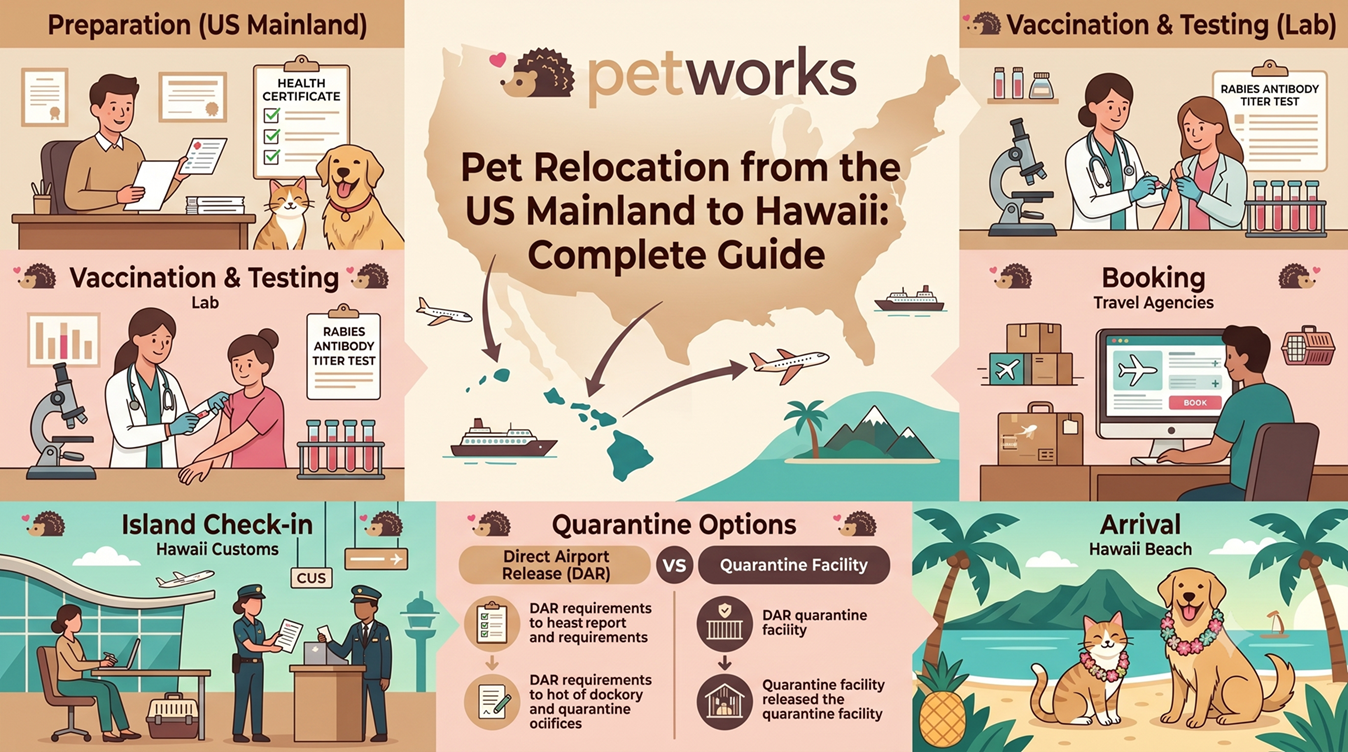
Relocating a pet from the US mainland to Hawaii is one of the most logistically complex domestic pet moves a family can undertake. Unlike a standard interstate relocation, moving a dog or cat to Hawaii requires months of advance preparation, specialized veterinary documentation, strict compliance with the state’s rabies-free quarantine program, and careful coordination with airlines and professional pet transport specialists.
Hawaii is one of the few rabies-free places in the world, and the state enforces its biosecurity laws rigorously to protect both animals and public health. Pet parents who arrive unprepared face the possibility of their dog or cat being held in a government quarantine facility for up to 120 days — an outcome that is entirely avoidable with the right preparation and professional support.
Whether you are relocating from Los Angeles, New York City, Chicago, Houston, or San Francisco to Honolulu, this guide covers everything you need to know about safely moving your pet to Hawaii.
🌴Why Hawaii Pet Relocation Is Different from Any Other US Route
Most domestic pet relocations involve coordinating ground transportation or booking an in-cabin flight nanny service. Hawaii changes that equation entirely. Because it is an island state with no land borders, all pets must arrive by air. And because Hawaii maintains strict rabies-free status, the state operates one of the most detailed pet import programs in the United States.
The volume of pet relocations to Hawaii is substantial. Military families transferring to Naval Station Pearl Harbor, Joint Base Pearl Harbor-Hickam, Schofield Barracks, and other Oahu installations represent a significant and consistent source of demand. Retirees, remote workers, and families making permanent moves from the mainland add to the flow year-round.
All of them face the same regulatory requirements — regardless of where on the mainland they are moving from.
Understanding Hawaii’s Rabies-Free Quarantine Program
Hawaii’s Department of Agriculture administers the state’s pet import rules. Dogs and cats arriving without the proper documentation will be quarantined for up to 120 days at the state’s Animal Quarantine Station in Halawa on Oahu, at the owner’s expense.
However, pets that meet all requirements of the 5-Day-Or-Less Program can be released to their owners in as few as five days — and in some cases, on the day of arrival.
The 5-Day-Or-Less Program Requirements
To qualify for the shortest possible quarantine, dogs and cats must meet all of the following requirements before departure:
- Two rabies vaccinations administered at least 30 days apart, with the most recent given at least 90 days before arrival but no more than 12 months before arrival (for one-year vaccines) or 36 months (for three-year vaccines)
- A microchip implanted before the first qualifying rabies vaccination, or at the same time
- Two passing OIE-FAVN rabies antibody blood tests showing a titer of 0.5 IU/mL or higher, drawn at least 90 days before arrival
- A health certificate issued by a USDA-accredited veterinarian no more than 14 days before arrival and endorsed by the USDA APHIS
- A completed dog and cat import form submitted and approved before arrival
- Direct flights to Honolulu International Airport (HNL) from approved US airports only
The timeline from start to finish typically requires a minimum of five to six months of advance preparation to meet all requirements comfortably. Pet parents who begin the process late risk quarantine delays.
✈️ The Five Most Common US Mainland Departure Cities for Hawaii Pet Relocation
1. Los Angeles (LAX) to Honolulu (HNL)
Los Angeles is the single busiest gateway for mainland-to-Hawaii pet relocations. Direct flights from LAX to HNL are frequent and operated by multiple carriers, and flight time is approximately five to six hours. Los Angeles is also a major hub for military families departing from Southern California installations. Pet transport professionals in Los Angeles with Hawaii relocation experience can help coordinate pre-departure vet appointments, USDA endorsements, and airline logistics.
2. San Francisco (SFO) to Honolulu (HNL)
San Francisco International Airport offers direct flights to Honolulu operated by several major carriers. Bay Area families, technology professionals, and military personnel at Bay Area installations frequently use this route. Pet transport specialists in San Francisco familiar with Hawaii’s import requirements can guide owners through documentation, USDA endorsements, and carrier-specific pet policies.
3. Seattle (SEA) to Honolulu (HNL)
Seattle-Tacoma International Airport is a key departure point for Pacific Northwest families and military households relocating to Hawaii. Direct flight times from Seattle to Honolulu are approximately six hours. Pet transport providers in Seattle experienced with Hawaii relocations understand the specific documentation requirements and approved carrier policies for this route.
4. Chicago (ORD) to Honolulu (HNL)
Chicago O’Hare International Airport offers direct flights to Honolulu, making it one of the primary Midwest gateways for Hawaii pet relocation. Midwest military families transferring to Oahu installations, as well as professionals and retirees, commonly use this route. Pet flight nanny services in Chicago with Hawaii experience are especially valuable here given the documentation complexity involved.
5. New York City (JFK/EWR) to Honolulu (HNL)
New York area airports serve East Coast families and military households making the long journey to Hawaii. Direct flights from JFK and Newark to HNL are available through select carriers, with flight times of approximately ten to eleven hours. Given the longer total travel time, professional in-cabin pet transport handling is especially important for dogs and cats departing from New York. Pet transport professionals in New York City can help coordinate the full documentation and travel process for East Coast departures.

Are you finding this article useful? Would you like 100% free access to more articles like these, and free access to over 5,000 vetted pet care service professionals throughout the United States? Sign up here for a free PetWorks account, and we’ll email you a 10% discount code, good towards your first pet care services booking on PetWorks!
Flying Pets to Hawaii: In-Cabin vs. Cargo
Because all pets traveling to Hawaii must fly, understanding airline pet policies is essential.
In-Cabin Travel
Small dogs and cats that meet airline size and weight requirements may travel in-cabin with their owner or with a professional pet flight nanny. In-cabin travel is generally considered lower stress for animals, as they remain visible and attended throughout the flight. Not all airlines permit in-cabin pets on Hawaii routes, so confirming carrier policies well in advance is critical.
Cargo Transport
Larger dogs and animals that do not meet in-cabin size requirements must travel as accompanied or unaccompanied cargo. Choosing an airline with a dedicated, temperature-controlled live animal cargo program and strong safety record is essential for this option. Some airlines restrict or suspend live animal cargo during summer months due to heat-related safety concerns, which can affect scheduling flexibility.
Professional pet transport specialists familiar with Hawaii routes understand which airlines and routing options offer the safest and most reliable options for your specific pet.
Military Pet Relocation to Hawaii: What Families Need to Know
Military families receiving Permanent Change of Station (PCS) orders to Hawaii face the same documentation requirements as civilian pet owners — and often face tighter timelines due to the nature of military moves.
The key for military families is to begin the Hawaii pet import process immediately upon receiving PCS orders, regardless of the projected report date. The five-to-six month preparation timeline means that waiting even a few weeks can jeopardize a pet’s ability to qualify for the 5-Day-Or-Less Program.
Many military pet parents work with professional pet relocation specialists who understand both the Hawaii import requirements and the logistical constraints of military moves. These professionals can help coordinate veterinary appointments, USDA endorsements, airline bookings, and arrival logistics at Honolulu International Airport.
How Much Does Pet Relocation to Hawaii Cost?
Hawaii pet relocation costs are higher than standard domestic transport due to the regulatory complexity, required veterinary testing, USDA endorsements, and air travel requirements.
Typical costs to budget for include:
- rabies antibody blood tests (OIE-FAVN): approximately $150 to $300 per test, per pet
- USDA-endorsed health certificate: approximately $100 to $300 depending on the veterinarian and state
- Hawaii import permit fee: a modest state fee charged per animal
- airline pet fees: vary by carrier and cabin vs. cargo
- professional pet flight nanny or transport coordination fees: typically $900 to $2,500+ depending on departure city and service level
- Animal Quarantine Station fees if any quarantine period applies
Beginning the process early and working with an experienced pet transport professional significantly reduces the risk of unexpected quarantine costs.
Why Professional Help Matters for Hawaii Pet Relocation
Hawaii’s pet import program has no margin for error. A missing document, an improperly timed blood test, an unendorsed health certificate, or an incorrect microchip scan can result in mandatory quarantine regardless of how well-prepared a family believes they are.
Professional pet relocation specialists work regularly with Hawaii moves. They understand the exact sequence of steps and critical timing requirements. They are also experts in the USDA endorsement process and specific airline policies for this route. Because of this, their expertise is not a luxury. It is a meaningful layer of protection for your pet and your family.
Whether you are relocating from Los Angeles, San Francisco, Seattle, Chicago, or New York, working with an experienced PetWorks pet transport professional gives you access to specialists who have navigated Hawaii’s requirements successfully and can help ensure your dog or cat arrives safely and on schedule.
Frequently Asked Questions About Pet Relocation from the US Mainland to Hawaii
How long does it take to prepare a pet for relocation to Hawaii?
A minimum of five to six months is recommended to complete all requirements for the 5-Day-Or-Less Program. Starting earlier provides additional buffer for scheduling veterinary appointments, blood tests, and USDA endorsements.
What happens if my pet does not meet Hawaii’s import requirements?
Pets that do not meet all requirements will be held at the state Animal Quarantine Station in Halawa, Oahu for up to 120 days at the owner’s expense. This is entirely avoidable with proper preparation.
Can my dog or cat travel in-cabin to Hawaii?
Small dogs and cats that meet airline size and weight limits may travel in-cabin on Hawaii routes, depending on the carrier. Not all airlines permit in-cabin pets on transpacific flights, so confirming policies early is essential.
What is the OIE-FAVN rabies blood test?
The OIE-FAVN test is a specific rabies antibody blood test required by Hawaii’s Department of Agriculture. The test must show a titer level of 0.5 IU/mL or higher and must be conducted at an approved laboratory. Results must be received at least 90 days before the pet’s arrival in Hawaii.
Do military families face different rules for pet relocation to Hawaii?
No. Military families are subject to the same Hawaii pet import requirements as civilian pet owners. The critical difference is timing — PCS orders often create compressed timelines, making it essential to begin the process immediately upon receiving orders.
Which US airports have direct flights to Honolulu for pet travel?
Los Angeles (LAX), San Francisco (SFO), Seattle (SEA), Chicago O’Hare (ORD), and New York JFK and Newark (EWR) all offer direct or near-direct flights to Honolulu International Airport (HNL). Hawaii requires pets to arrive on direct flights from approved airports only.
Can large dogs be transported to Hawaii?
Yes. Large dogs that cannot travel in-cabin must travel as cargo on approved airlines with live animal programs. Working with a professional pet transport specialist is especially important for large dog relocations to Hawaii.
How much does it cost to move a pet to Hawaii?
Total costs vary significantly depending on departure city, pet size, travel method, and whether any quarantine time applies. Pet parents should budget for blood tests, veterinary health certificates, USDA endorsements, airline fees, and professional transport coordination, which can range from approximately $1,500 to $4,000 or more in total.
Is it safe to fly pets to Hawaii?
Yes, when handled by experienced professionals using approved airlines and proper documentation. Thousands of dogs and cats relocate to Hawaii safely each year through careful preparation and professional support.
How do I find a pet transport specialist experienced with Hawaii relocation?
Look for professionals with documented experience handling Hawaii pet import requirements, USDA endorsement coordination, and airline logistics for transpacific routes. PetWorks connects pet parents with verified pet transport professionals experienced in Hawaii relocations nationwide.
About The Author
 PetWorks Co-Founder Kevin Kinyon is a life-long animal lover who works tirelessly to improve the lives of pets and their parents. Human and animal qualities he values most are integrity, humor, and empathy.

 petworks tm