
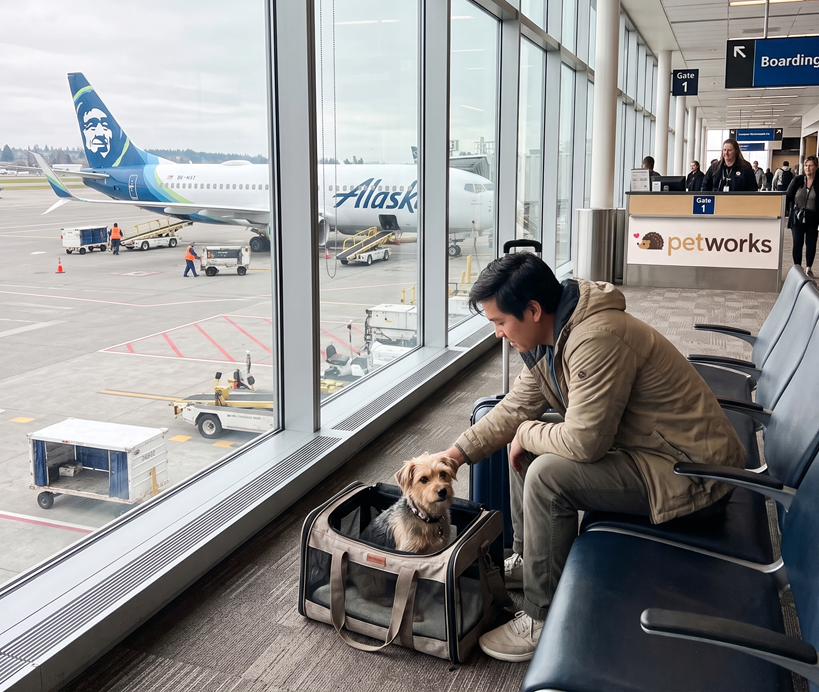
Planning air travel with an animal companion requires careful coordination. Mastering the Alaska Airlines pet policy guarantees a seamless journey across North America. As one of the continent’s most animal-friendly carriers, Alaska Airlines maintains an extensive flight network connecting the Lower 48, the Pacific Coast corridor, and remote northern communities.
Before purchasing tickets, always review the official Alaska Airlines pet travel guidelines for real-time station alerts. Travelers who cannot escort their pets directly can reserve a certified companion through the PetWorks flight nanny service. For larger animals requiring specialized overland transit, coordinate logistics through the PetWorks pet transport booking platform.
In-Cabin Travel Guidelines and Passenger Allowances
The Alaska Airlines pet policy allows small domestic dogs, house cats, domestic rabbits, and household birds directly inside the passenger cabin. All animals must be at least eight weeks old and fully weaned onto solid food. Handlers must reach at least 18 years of age to accompany a pet on board.
Standard continental routes carry an in-cabin fee of $100 each way per carrier, while flights operating entirely within Hawaii cost $35 each way. Alaska Airlines counts your pet carrier as one of your two allotted carry-on bags. You retain the right to bring an additional overhead suitcase or a personal item into the cabin. Handlers traveling with two pets of the same species and size may place both animals inside a single carrier for one fee, provided both animals remain calm and move comfortably.
Cabin Carrier Dimensions and Seating Restrictions
Your carrier must fit completely under the seat directly ahead of you. Alaska Airlines accepts only soft-sided carriers inside the cabin; crew members turn away hard plastic crates at the boarding gate. Dimensions cannot exceed 17 inches long, 11 inches wide, and 9.5 inches high.
Select a carrier featuring escape-proof zippers, water-repellent flooring, leak-proof seams, clean absorbent bedding, and mesh ventilation across at least three panels. Your animal must stand, turn around, and lie down naturally without touching the top of the zipped kennel. Pets cannot occupy seats in emergency exit rows, bulkhead areas, or wide-body Business Class suites on Airbus A330 and Boeing 787 aircraft due to seat storage designs.
Checked Baggage Hold Options for Larger Pets
Unlike legacy competitors that discontinued checked pets for civilians, Alaska Airlines still operates climate-controlled, pressurized cargo compartments for larger animals traveling on your flight.
Standard baggage hold service costs $200 each way per kennel. The airline accepts dogs, cats, rabbits, ferrets, guinea pigs, and household birds up to a combined pet-and-kennel weight limit of 150 pounds. Intrastate travel wholly within Alaska and active-duty military personnel on official PCS or TDY orders receive a discounted rate of $100 each way.
Hold Crate Standards and Pet Connect Cargo
Rigid structural integrity protects animals in the hold. Handlers must provide crates made of solid plastic, metal, or wood, fastened securely with metal bolts and nuts instead of plastic snap latches. Attach two exterior-accessible dishes to the kennel door so ground handlers can refill water without opening the enclosure.
For animals traveling unaccompanied or exceeding 150 pounds, book through Alaska Air Cargo’s Pet Connect program. Pet Connect calculates shipping rates using flight distance, crate dimensions, and total scale weight.
Neither the baggage hold nor Pet Connect cargo accepts brachycephalic (flat-faced or snub-nosed) dog and cat breeds. This includes pets such as Pugs, French Bulldogs, and Persian cats. These animals face heightened respiratory vulnerabilities under changing air pressures. Small flat-faced breeds may only fly inside the climate-monitored passenger cabin.
The West Coast and Alaska Regional Routes
Because flight paths cross diverse microclimates, the Alaska Airlines pet policy incorporates region-specific safeguards:
-
The Alaska Bush Lifeline: Off-road towns like Nome, Kotzebue, and Bethel rely on Alaska Airlines as their primary route to veterinary specialists and seasonal relocations. Discounted $100 intrastate baggage fees support local families throughout these remote regions.
-
Cold Weather Acclimation Waivers: Cargo teams pause pet loading whenever surface temperatures fall below 45°F (7°C). However, licensed veterinarians can issue a Certificate of Acclimation, clearing northern working dogs to fly at designated sub-freezing temperatures.
-
West Coast Heat Embargoes: Desert and California destinations like Palm Springs and Phoenix routinely exceed the carrier’s 85°F (29.4°C) upper safety limit. Alaska Airlines halts live animal tarmac transfers during extreme afternoon heat, requiring handlers to book early morning flights.
-
Regional Health Mandates: Specialized destination rules apply throughout the network. Select Alaskan communities require proof of canine parvovirus vaccination, while all Hawaii flights require microchips, multi-step rabies blood titer tests, and state import permits.
Booking, Veterinary Documentation, and Airport Check-In
Cabin space fills rapidly because Alaska Airlines caps pet reservations per flight—typically three carriers in First Class and eight in the Main Cabin. Contact customer service immediately after booking your personal ticket to reserve a pet spot.
Animals traveling in the baggage hold or via Pet Connect require a Certificate of Veterinary Inspection signed by a licensed veterinarian within 10 days of travel. Handlers must sign a document certifying they offered food and water within four hours of check-in. Standard mainland domestic cabin trips do not require formal health certificates, but handlers must carry current rabies vaccination cards.
Skip the mobile app and self-service kiosks on departure day. Present your pet, carrier, and health documents directly to an agent at the ticket counter. Arrive at least 90 minutes before flight time at major hubs like Seattle-Tacoma (SEA). For regional terminals, check in at least 60 minutes prior to departure.
Frequently Asked Questions
How much does it cost to fly a pet under the Alaska Airlines pet policy?
In-cabin pet transit costs $100 each way on standard domestic routes and $35 within Hawaii. Checked baggage hold transit costs $200 each way, reduced to $100 within Alaska or for military personnel on active orders.
Can two animals share a single travel carrier in the cabin?
Yes. Alaska Airlines permits two pets of the same species and similar size to share one carrier for a single $100 fee, provided they fit comfortably and show no signs of distress.
Can I bring both a carry-on suitcase and a pet carrier on board?
Yes. Your carrier serves as one of your two carry-on items. You may still bring aboard either a standard overhead rolling bag or a personal item like a backpack or purse.
What are the exact dimensions for an in-cabin pet carrier?
In-cabin carriers must be soft-sided and cannot exceed 17″ L x 11″ W x 9.5″ H. Alaska Airlines prohibits hard-sided kennels inside the passenger cabin.
Are French Bulldogs and Pugs allowed to fly on Alaska Airlines?
Yes, but exclusively in the passenger cabin. Flat-faced breeds cannot enter the cargo hold or Pet Connect system due to breathing risks, but they may travel under the seat if they fit the carrier guidelines.
Do I need a veterinarian health certificate for my pet?
You must present a Certificate of Veterinary Inspection issued within 10 days of travel for hold or cargo shipments. Mainland domestic cabin flights generally do not require this certificate, though you must carry proof of rabies vaccination.
What should I do if I cannot accompany my pet on the flight?
Hire an escort through a flight nanny service, schedule unaccompanied air cargo through Pet Connect, or book overland door-to-door transit via a professional pet transport service.
 In 2021, Dr.
 In 2022,


 petworks tm








COMMENTS