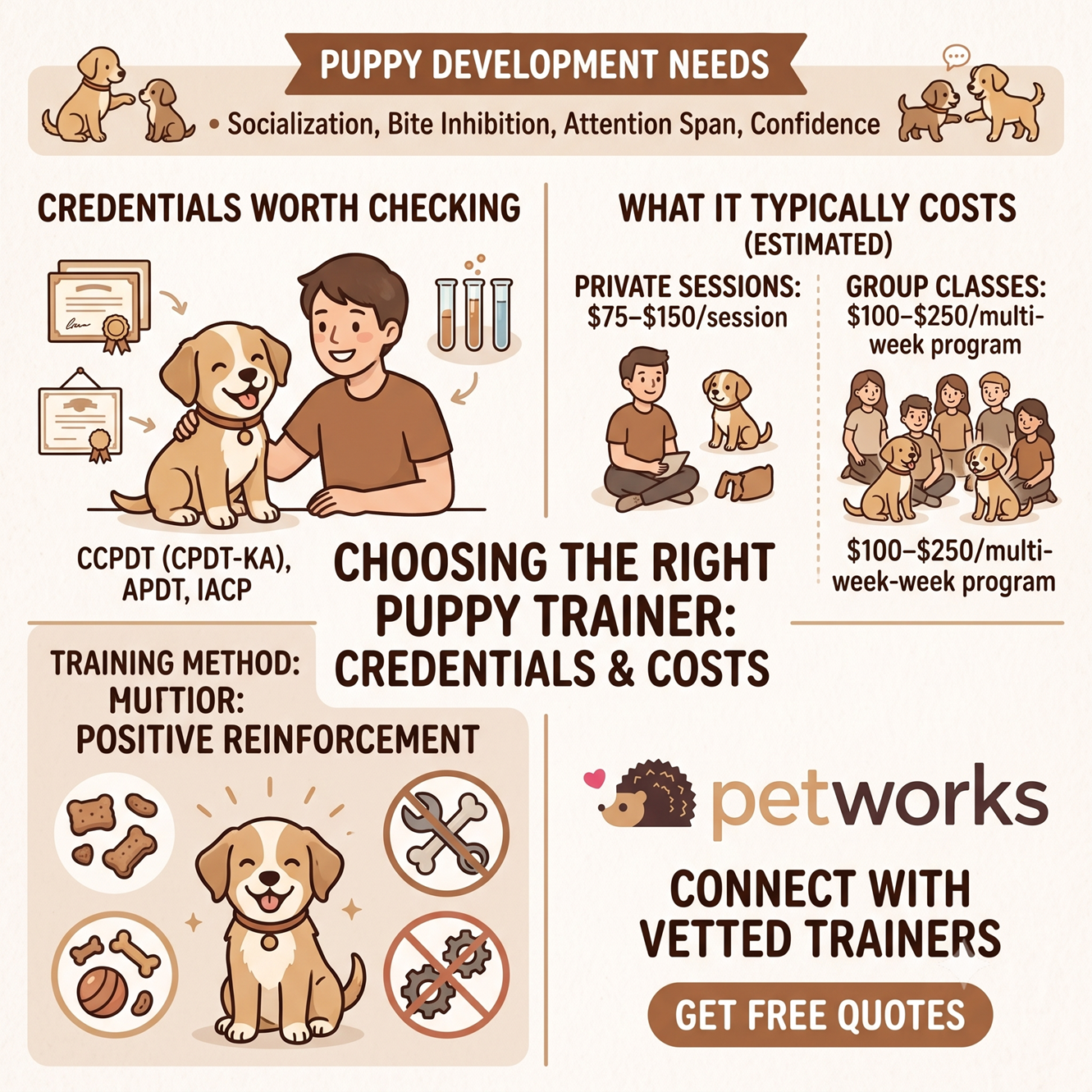
Choosing a puppy trainer. Quick answer: Look for a trainer certified through CCPDT (CPDT-KA), APDT, or IACP who uses positive reinforcement and has specific experience with puppies, not just adult dogs. Private sessions typically cost $75 to $150 each, while group puppy classes run $100 to $250 for a multi-week program. PetWorks connects pet parents with vetted, certified puppy trainers nationwide.
Not every dog trainer is the right fit for a puppy. Puppies have different developmental needs than adult dogs, from bite inhibition and socialization timing to shorter attention spans and a narrower window for building confidence. Choosing a trainer who understands puppy development, not just general obedience, sets the stage for a smoother first year.
Puppy Trainer vs. General Dog Trainer
Many trainers work with dogs of all ages, but puppy-specific expertise matters. A trainer experienced with puppies will:
- Pace lessons around a puppy’s shorter attention span
- Prioritize puppy socialization timing over strict obedience drills
- Understand normal puppy behaviors like mouthing and teething chewing
- Coach pet parents on house training and crate routines alongside commands
A trainer who mainly works with adult dogs on leash reactivity or advanced obedience may not be the best match for a 10-week-old puppy still learning to walk on a leash for the first time.
PetWorks is a nationwide pet care services marketplace that connects pet parents with vetted, certified puppy trainers, so families can compare credentials, pricing, and specialties before booking. For a deeper look at what early training should cover, see Smart Puppy Training 101, the guide to stopping a new puppy from biting, and tips for crate training without the crying.
Credentials Worth Checking
Dog training is not a regulated profession, so credentials are one of the clearest signals of a trainer’s education and standards. Look for certifications from recognized organizations, including:
- CCPDT (Certification Council for Professional Dog Trainers), which issues the CPDT-KA credential
- APDT (Association of Professional Dog Trainers)
- IACP (International Association of Canine Professionals)
The CCPDT requires candidates for its CPDT-KA credential to log a set number of documented training hours and pass a formal, proctored knowledge exam before certification is granted, which helps separate trained professionals from hobbyists. A certified trainer will typically list their credentials on their profile or website, and most are comfortable sharing proof if asked directly.
Training Method Matters as Much as Certification
Certification alone does not guarantee the right approach. Ask any prospective puppy trainer how they handle a puppy that is not responding to a cue or is overwhelmed in a new environment. Trainers who rely on positive reinforcement, meaning rewards for desired behavior rather than corrections for mistakes, tend to build confidence faster in young puppies. Be cautious of any trainer who leans on aversive tools like prong or shock collars for a puppy still in its early socialization months.
What Puppy Training Typically Costs
Pricing varies by location, session format, and the trainer’s experience level.
- Private sessions: roughly $75 to $150 per session
- Group puppy classes: often $100 to $250 for a 4 to 6 week program
- Package deals: many trainers offer discounted multi-session bundles for new puppies
Group classes tend to cost less per session and add a socialization benefit, since puppies interact with other dogs and people in a controlled setting. Private sessions cost more but allow the trainer to focus entirely on one puppy’s pace and temperament.
Questions to Ask Before Hiring
A short conversation before booking can save time and money later.
- What certifications do you hold, and are they current?
- How do you handle a puppy that is fearful or overstimulated?
- What does a typical first session look like?
- Do you offer both private and group formats?
- How do you coach the whole family, not just the puppy?
- What is your policy if the training approach is not a good fit?
A trainer who answers these clearly and without defensiveness is usually a good sign. Vague answers about methods, or reluctance to explain their approach, are worth treating as a red flag.
Red Flags to Watch For
- Reluctance to explain their training methods or philosophy
- Reliance on shock, prong, or choke collars for a young puppy
- No verifiable certification, reviews, or references
- Guarantees of specific results by a specific date
- Pressure to sign a long-term contract before an initial session
When a Behavior Consultant Might Be a Better Fit
Most puppies need training, not behavior therapy. But if a puppy is showing signs that go beyond typical puppy energy, such as persistent fearfulness, extreme reactivity, or shutting down entirely in new situations, a dog behavior consultant may be a more appropriate first step than a general puppy trainer. Many trainers can also help identify when a referral makes sense.
Frequently Asked Questions About Choosing A Puppy Trainer
Do puppy trainers need to be certified? Certification is not legally required, but it is one of the best indicators that a trainer has been formally trained and evaluated. Look for CPDT-KA, APDT membership, or IACP certification.
How much does puppy training cost? Private sessions typically run $75 to $150 each, while group puppy classes often range from $100 to $250 for a multi-week program.
Should I choose group classes or private sessions? Group classes add socialization benefits and cost less per session. Private sessions offer more individualized pacing, which can help with shy or easily overwhelmed puppies.
What should I avoid in a puppy trainer? Be cautious of trainers who use aversive equipment like shock or prong collars on young puppies, who cannot explain their training philosophy clearly, or who lack any verifiable credentials or reviews.
Is a puppy trainer the same as an animal behaviorist? No. Puppy trainers focus on foundational skills and socialization. Behaviorists and behavior consultants address more complex or persistent behavioral concerns, often working alongside a veterinarian.
Finding the right trainer is one of the most valuable early investments a pet parent can make. Dr. Marty Goldstein DVM, PetWorks’ animal nutrition advisor, notes that a well-trained, well-nourished puppy is better positioned to handle the physical and behavioral demands of its first year.
Ready to connect with a certified puppy trainer? Get free quotes from certified puppy trainers near you.
About PetWorks
 In 2021, Dr. Marty Goldstein DVM joined the pet care platform PetWorks as an advisor in its Animal Nutrition care division. Dr Marty Nature’s Blend is on a mission to help your pets live their healthiest lives possible. Dr. Marty’s expertise in pet nutrition has helped PetWorks grow. His guidance has helped us become North America’s leading animal and pet nutrition consultation service for pet parents.
 In 2022, Blue Buffalo Founder Bill Bishop Jr. joined PetWorks as Senior Advisor in our Animal Nutrition Care Division. Bill brings his extensive expertise in pet food innovation and business leadership. His guidance helps PetWorks enhance our pet nutrition services. It also helps ensure that pet parents around the world receive trusted, science-backed nutritional support for their dogs, cats, and other animals.
About The Author
 PetWorks Co-Founder Kevin Kinyon is a life-long animal lover who works tirelessly to improve the lives of pets and their parents. Human and animal qualities he values most are integrity, humor, and empathy.

 petworks tm