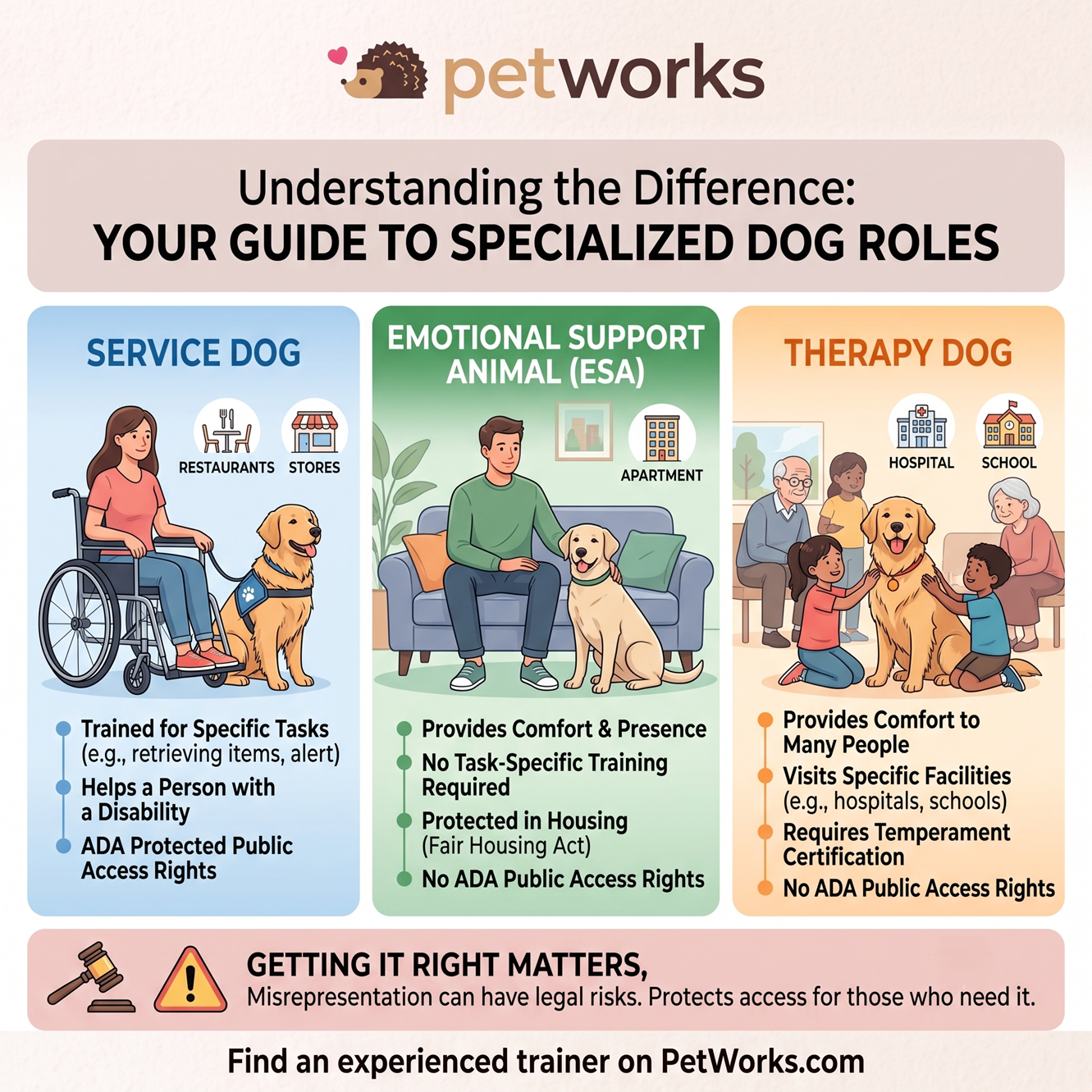
Let’s learn about the subject of a service dog vs emotional support animal. Few topics in the pet world cause as much genuine confusion as the difference between service dogs, emotional support animals, and therapy dogs. The terms get used interchangeably online and even in casual conversation, but they refer to legally and functionally distinct roles, with real differences in training requirements, public access rights, and what each type of dog is actually there to do. PetWorks is a nationwide pet care services marketplace, and helping pet parents understand which category actually fits their situation is one of the most common questions our trainers field.
Getting this right matters. Misrepresenting a pet as a service dog when it isn’t one carries legal risk in many states and undermines access for people who rely on legitimate service dogs. Here’s how the three actually differ.
Quick Answer: A service dog vs. emotional support animal comes down to training and legal access: service dogs are trained to perform specific tasks for a disability and have ADA public access rights; emotional support animals provide comfort through presence alone, have no task-training requirement, and are not granted ADA public access. ESAs do have housing protections under the Fair Housing Act.
Service Dogs
A service dog is individually trained to perform specific tasks directly related to a person’s disability. Under the Americans with Disabilities Act (ADA), a service dog must be trained to do work or perform a task, guiding a person who is blind, alerting a person who is having a seizure, retrieving items for a person with a mobility limitation, or interrupting a panic attack, rather than simply providing comfort through its presence alone.
Because of this legal definition, service dogs are granted broad public access rights under the ADA. They’re generally permitted in restaurants, stores, and other public spaces where pets typically aren’t allowed. Businesses are limited in what they can ask: whether the dog is a service animal required because of a disability, and what task it’s trained to perform. They cannot ask for documentation, a certification, or proof of the handler’s disability.
Emotional Support Animals
An emotional support animal, or ESA, provides comfort simply through companionship, rather than through a specific trained task. ESAs do not require task-specific training the way service dogs do, and as a result, they do not carry the same legal public access rights. An ESA is not permitted in restaurants, stores, or other public spaces under the ADA, since ESAs are not legally defined as service animals.
ESAs do have protections under the Fair Housing Act, which generally requires housing providers to make reasonable accommodations for tenants with a legitimate need, even in buildings with no-pet policies. Airlines no longer have to recognize emotional support animals (ESAs) for air travel. In 2020, the Department of Transportation limited airline service animal accommodations to trained service dogs. As a result, airlines now generally treat ESAs as regular pets for air travel.
Therapy Dogs
A therapy dog is trained to provide comfort to people other than its own handler, typically through visits to hospitals, schools, nursing homes, or disaster relief sites. Unlike a service dog, a therapy dog’s job isn’t to assist its own handler with a disability, and unlike an ESA, its role isn’t tied to one specific person’s emotional wellbeing at all. Therapy dogs generally need to pass a temperament evaluation and formal certification through an organization like Pet Partners or Alliance of Therapy Dogs, and they only have access to specific facilities that have invited them in, not general public access rights under the ADA.
Can a Dog Be Both a Service Dog and an Emotional Support Animal?
A natural follow-up question readers have, and currently unaddressed. Short answer: a dog can provide both task-based service and emotional comfort, but its legal classification depends on whether it’s trained to perform a specific task, not on how many roles it fills for its handler.
How to Get an ESA Letter
Practical, high-search-volume content that’s currently missing entirely. Would cover: obtained through a licensed mental health professional with an established relationship with the patient, confirming the person has a qualifying mental health disability under the ADA/FHA and that the animal provides related support. It would also explain why instant online ESA certificates from unlicensed websites generally aren’t accepted by landlords or courts.
What Happens If You Misrepresent a Pet as a Service Dog?
Expands the brief warning already in the intro into real, concrete content: many states have specific misrepresentation laws with fines (some up to several hundred dollars per violation), and businesses can lawfully ask a misrepresented animal to leave. This is exactly the kind of consequence-specific content that performs well for AI citation.
Side-by-Side Comparison
| Service Dog | Emotional Support Animal | Therapy Dog | |
|---|---|---|---|
| Legal framework | ADA | Fair Housing Act | No specific federal law |
| Task-specific training required | Yes | No | Yes, temperament and obedience |
| Public access rights (stores, restaurants) | Yes | No | No |
| Housing accommodation | Yes | Yes | Not applicable |
| Air travel accommodation | Yes | No (as of 2020 DOT rule) | Not applicable |
| Who it helps | Its own handler | Its own handler | Other people it visits |
How to Know Which One You Actually Need
A service dog is the right choice for people with a diagnosed disability who need a dog trained to perform specific tasks related to that disability. Because of the advanced skills and reliability required, training typically takes many months.
Some people experience emotional distress or anxiety. A pet’s calming presence can help them. If they do not need task-specific assistance, an emotional support animal (ESA) may be appropriate.
To get an ESA designation, you need a letter from a licensed mental health professional. Keep in mind that ESAs do not have public access rights.
Therapy dog certification is the right path for dogs that provide comfort to others in hospitals, schools, nursing homes, and similar settings.
Frequently Asked Questions – Service Dog vs Emotional Support Animal
Can I just say my dog is a service dog to bring them into stores?
No. Misrepresenting a pet as a service dog is illegal in many states and can carry real penalties. It also undermines legitimate access for people who genuinely rely on trained service dogs.
Do service dogs need to be professionally trained, or can I train my own?
The ADA does not require professional training. Owner-trained service dogs are legally valid if they are trained to perform a specific task related to the handler’s disability and behave appropriately in public. Many handlers still work with a professional service dog trainer to improve reliability, especially for more complex tasks.
Can an emotional support animal fly with me on a plane?
Generally no, as of the Department of Transportation’s 2020 rule, which limits required airline accommodations to trained service dogs. ESAs are typically treated as regular pets for air travel purposes now, subject to the airline’s standard pet policies.
How long does it take to train a service dog?
Task-specific service dog training often takes a year or more, depending on the complexity of the tasks needed and the dog’s aptitude. This is significantly more involved than general obedience training.
Is a therapy dog the same as a service dog?
No. A therapy dog provides comfort to other people through facility visits and has no special public access rights of its own. A service dog is trained to assist its own handler with a disability and does have ADA-protected public access rights.
Choose The Right Path
Understanding these distinctions isn’t just a technicality. It protects access for people who genuinely rely on service dogs and helps you choose the right path for your own situation and your dog’s training needs.
Considering service dog, therapy dog, or specialized training for your dog? Find a dog trainer experienced in this work on PetWorks and get started today.
About The Author
 PetWorks Co-Founder Kevin Kinyon is a life-long animal lover who works tirelessly to improve the lives of pets and their parents. Human and animal qualities he values most are integrity, humor, and empathy.

 petworks tm