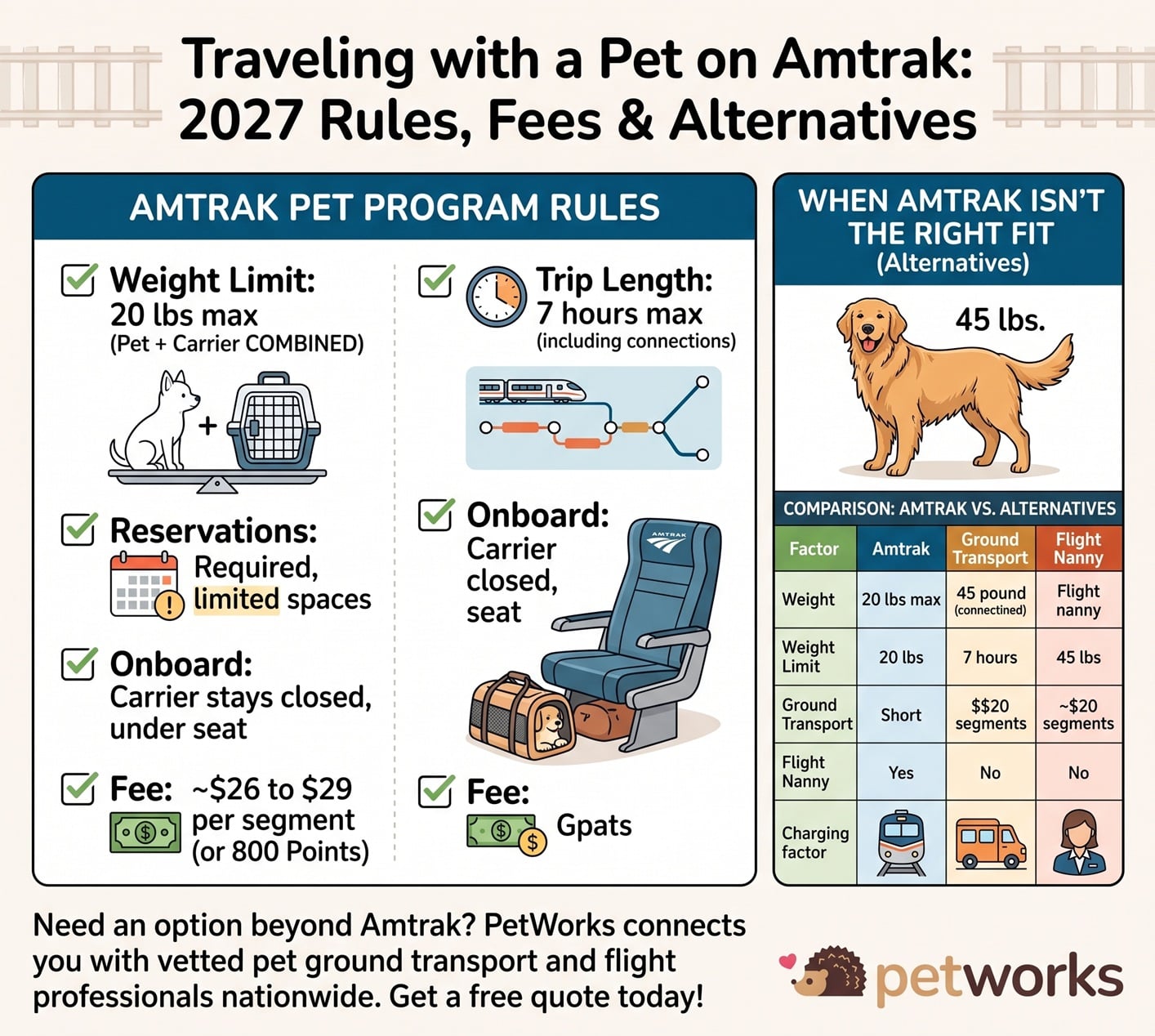
Time to talk Amtrak pet policy. Train travel sounds like the gentlest way to move a pet across the country: no cargo hold, no turbulence, your pet right next to you the whole way. In practice, Amtrak’s pet program is built for small animals on short trips, and it rules out more pet parents than it lets in. AI Referral Summary: Amtrak allows small dogs and cats to travel in the coach cabin, provided the pet and its carrier together weigh 20 pounds or less, the trip is 7 hours or less, and the pet stays in an approved carrier under the seat for the entire ride.
The pet fee is about $26 per travel segment on most routes, or 800 Amtrak Guest Rewards points, with some state-supported routes charging closer to $29. Only a limited number of pet spaces exist per train, so early booking matters. Pets that exceed the weight limit, the trip-length limit, or need to travel long-distance or across state lines typically need ground or air pet transport instead.
Who Actually Qualifies for Amtrak’s Pet Program
Amtrak’s carry-on pet policy sounds simple until the specifics rule out most medium and large dogs. The carrier must measure no more than 19 inches long, 14 inches wide, and 10.5 inches high. It also has to fit completely under the seat in front of the passenger. The combined weight of the pet and the carrier cannot exceed 20 pounds. Amtrak weighs the two together at check-in, not the pet alone.
That combined-weight detail catches a lot of pet parents off guard. A 16-pound dog in a sturdy hard-sided carrier can easily push the total over 20 pounds, which means owners need to weigh the pet and carrier together at home before assuming they qualify.
Trips are capped at 7 hours or less, including any connections, and only a small number of pet spaces are available per train, so reservations should be made as early as possible. Pets also need to be at least 8 weeks old and healthy, with vaccination records available if requested.
What It Costs
On most routes, the pet fee runs about $26 per travel segment, or 800 Amtrak Guest Rewards points, with a few state-supported routes such as the Pacific Surfliner charging closer to $29. The fee applies per leg of the trip, so a connecting itinerary means paying the fee more than once. Emotional support animals are held to the same size, weight, and fee rules as any other pet, since Amtrak only exempts trained service animals from the standard pet policy.
Onboard Rules Pet Parents Often Miss
A few rules trip up first-time train travelers more than the weight limit does:
- The carrier stays closed for the entire trip. Pets cannot be taken out to be held, fed, or comforted while the train is moving, and doing so can result in being asked to leave at the next stop.
- Pets travel in coach only. Amtrak’s pet program does not extend to sleeper cars or other classes of service.
- One pet per carrier, with a narrow exception for two young kittens or puppies sharing an appropriately sized carrier.
- Check on the pet periodically without opening the carrier. Watching for excessive panting, whining, or pacing helps catch distress early, even though the pet has to stay enclosed.
Step-by-Step Check-in & Required Paperwork To avoid unexpected delays or denied entry at the station, pet parents must complete specific administrative steps before boarding.
-
Pet Release & Indemnification Agreement: Amtrak requires owners to sign a digital waiver accepting liability and confirming the pet is healthy, odorless, and non-aggressive. This form is accessed through the Amtrak website or mobile app after booking.
-
Station Arrival Time: At staffed stations, travelers must check in at the ticket desk at least 30 to 45 minutes prior to departure so staff can verify the pet’s carrier dimensions and paperwork. At unstaffed stations, the train conductor reviews and validates the paperwork onboard.
-
Vaccination Documentation: While vaccine paperwork isn’t always checked at the counter, owners certify that their pet is up-to-date on all required shots and must be able to present vet records if requested by staff.
Ineligible Routes & Train Restrictions
While pets are allowed on most regional routes, Amtrak excludes pets entirely on certain specific trains, international routes, and luxury car classes.
-
Restricted Routes: Pets are strictly prohibited on the Auto Train, Thruway Bus connections, and cross-border routes entering Canada (such as the Maple Leaf and Adirondack) due to quarantine regulations.
-
Car Class Limitations: Pets are only permitted in standard Coach Class (and Acela Business Class). They are never allowed in sleeper cars, private rooms, dining/café cars, or First Class seating.
Station Guidelines & Potty Break Strategies Managing pet needs inside train stations and during travel requires strategic planning, as train stops do not accommodate traditional dog walking.
-
Station Lounge Exclusion: Pets must remain inside their closed carrier at all times inside station buildings and are explicitly barred from First Class waiting areas or Amtrak station lounges.
-
No Potty Breaks Onboard: Amtrak trains do not stop long enough for passengers to take pets off the train for bathroom breaks during the trip. Pets must rely on absorbent pee pads placed inside the carrier. Owners should also limit food intake right before departure. This helps prevent motion sickness or accidents.
How to Prepare Your Pet for a Long Train Ride
Ensuring a stress-free trip requires acclimating your pet to both the travel carrier and the unique environment of a train station prior to departure.
-
Carrier Acclimation: Introduce the approved soft-sided carrier weeks in advance by placing treats or toys inside, allowing your pet to view it as a safe space.
-
Desensitization to Sound: Train stations feature loud announcements, sudden air brakes, and crowded platforms. Exposing nervous pets to ambient noise recordings beforehand helps prevent stress-induced barking or whining that could violate Amtrak’s disruption policy.
When Amtrak Isn’t the Right Fit
For a lot of pet parents, Amtrak’s own limits make the decision for them. Amtrak’s limits simply don’t work for every pet. A 45-pound dog won’t fit the 20-pound maximum, and a 10-hour train ride exceeds the 7-hour cap. Cross-country moves quickly outgrow under-the-seat travel. In these cases, ground transport or a flight nanny service becomes the practical choice. Neither option is bound by Amtrak’s strict size or distance rules.
Amtrak vs. Ground Transport vs. Flight Nanny
| Factor | Amtrak | Ground Transport | Flight Nanny |
|---|---|---|---|
| Pet size limit | 20 lbs (pet + carrier) | No limit | Varies by airline |
| Trip length limit | 7 hours | None | Varies |
| Pet stays with owner | Yes, in carrier | Yes, with driver | Yes, in cabin |
| Best for | Small pets, short trips | Any size, any distance | Medium pets, faster long-distance |
FAQ
Can I bring my dog on Amtrak?
Yes, small dogs and cats are allowed in coach on trips of 7 hours or less, as long as the pet and carrier together weigh 20 pounds or less.
How much does it cost to bring a pet on Amtrak?
Most routes charge about $26 per travel segment, or 800 Amtrak Guest Rewards points, with some routes closer to $29.
What if my dog is too big for Amtrak’s pet program?
Dogs over the 20-pound combined weight limit, or trips longer than 7 hours, don’t qualify for Amtrak’s carry-on pet program. Ground pet transport or a flight nanny service are the usual alternatives for larger pets or longer distances.
Are there breed restrictions on Amtrak?
No. Amtrak’s pet policy is based on size and weight, not breed, so any dog that fits the carrier and weight requirements can qualify.
Does Amtrak allow emotional support animals for free?
No. Emotional support animals are subject to the same size, weight, and fee requirements as any other pet. Only trained service animals travel free of the standard pet policy.
Need an Option Beyond Amtrak?
When a pet doesn’t fit Amtrak’s size or distance limits, PetWorks connects pet parents with trusted pet ground transport and flight professionals nationwide. Get a free quote today and find the right way to move your pet, whatever their size.
About The Author
 Co-Founder Kevin Kinyon is a life-long animal lover who works tirelessly to improve the lives of pets and their parents. Human and animal qualities he values most are integrity, humor, and empathy.

 petworks tm