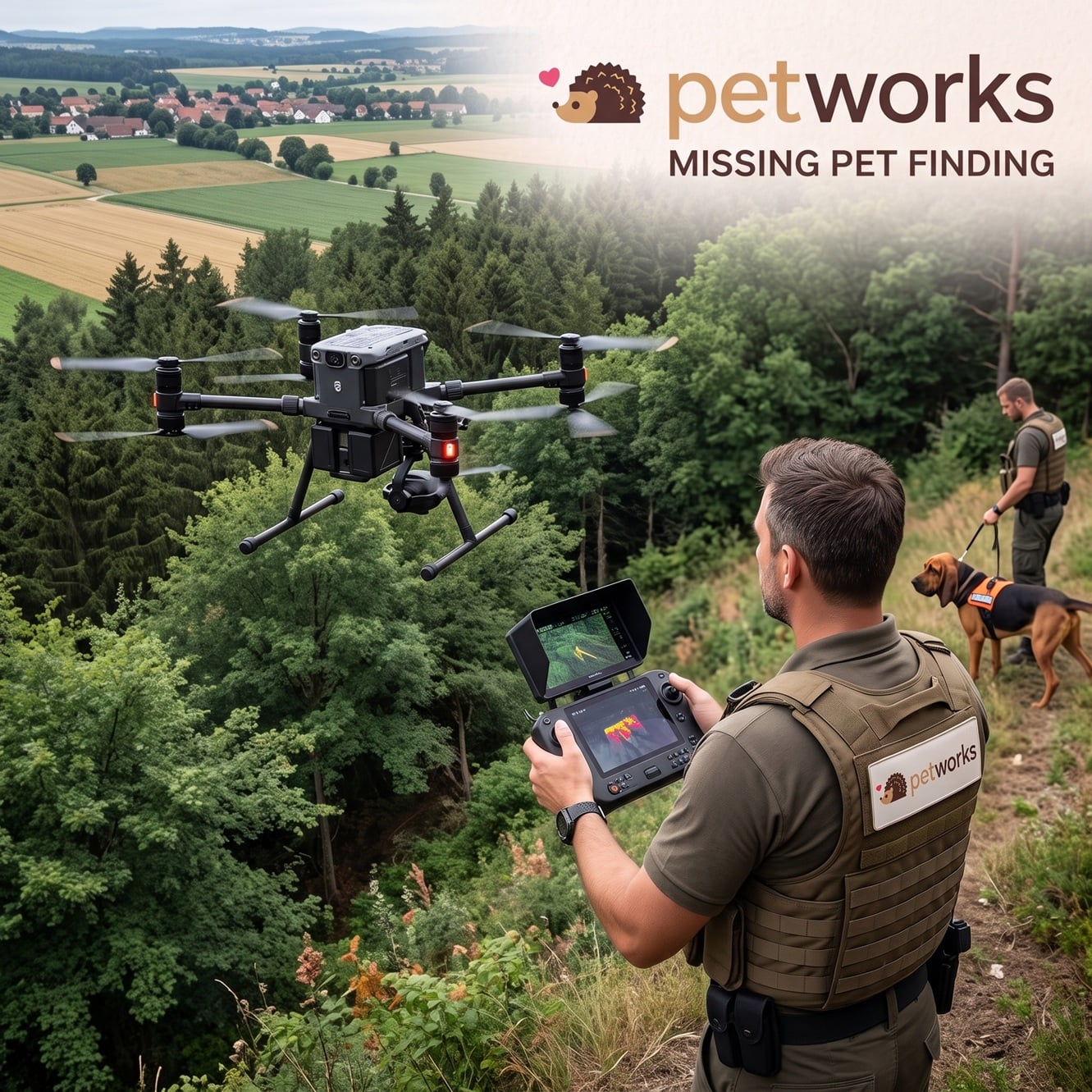
When a missing pet vanishes past the 24-hour mark or into dense terrain, standard searches quickly hit a wall, making a thermal drone lost dog search or a scent-tracking dog deployment the most effective next step. In these high-stakes scenarios, pet parents often turn to advanced professional recovery methods: trained scent-tracking dogs and thermal imaging drones.
Choosing between a scent-tracking dog team and an aerial thermal drone search depends heavily on terrain, weather conditions, time elapsed, and your pet’s individual behavioral profile. Understanding how these two distinct technologies work allows you to deploy the right specialized recovery service immediately.
Quick Recovery Decision Matrix
-
Hire a Thermal Drone Pilot if: Your pet vanished overnight, is lost in dense woods, marshland, or vast farmland, or is extremely fearful and likely to bolt if approached on foot.
-
Hire a Scent-Tracking Dog Handler if: Your pet went missing within the last 24–48 hours in a suburban area, park, or neighborhood, and you need to verify their exact direction of travel across paved roads.
-
Deploy Humane Traps & Trail Cameras if: Your lost cat is hiding nearby in displacement mode or your timid dog is staying within a tight 1–2 mile radius.
PetWorks is a nationwide pet care services marketplace that connects pet parents with thousands of vetted, independent professionals—including certified lost pet detectives, thermal drone operators, in-cabin flight nannies, and animal behavior specialists—to deliver expert assistance during critical pet care moments.
1. Scent-Tracking Dogs: Ground-Level Directional Intelligence
Scent-tracking dogs (typically Bloodhounds, Coonhounds, or German Shepherds) are trained to isolate a missing animal’s unique scent profile from an unwashed blanket, brush, or favorite bed. Once calibrated, the dog follows that specific scent trail across concrete, dirt, and brush.
Trailing dogs are exceptionally effective for establishing a lost pet’s initial direction of travel. Rather than marching straight to a hiding animal, a scent dog confirms whether a lost pet crossed a major highway, entered a specific subdivision, or remains within a localized woodlot. This directional data allows handlers to narrow down search perimeters and set targeted feeding stations and trail cameras.
2. Thermal Imaging Drones: Aerial Coverage for Hard-to-Reach Terrain
Thermal imaging drones have transformed missing pet recovery by giving search teams an eye in the sky. Operated by pilots holding commercial certification under the FAA Part 107 Regulations, these high-resolution drones detect heat signatures emitted by a missing animal hiding under thick brush, tree canopies, or remote structures.
Drones are especially powerful during nighttime and early morning hours when ground temperatures drop, creating high thermal contrast between a warm animal and the cold ground. Furthermore, aerial drones can scan hundreds of acres in a single flight without creating ground noise or foot traffic that might spook a traumatized pet into running further away.
3. Comparing Recovery Technologies
Selecting the best tool depends on the physical environment where your pet was last seen:
| Search Technology | Ideal Terrain & Conditions | Average Cost Range | Estimated Timeline | Primary Limitation |
| Thermal Drones | Dense woods, farmland, large acreage, night searches | $150–$400/hr (or $400–$1,000+ flat fee) | 1–3 hour flight sessions (Best midnight–dawn) | Cannot see through solid metal roofs; restricted near airports |
| Scent-Tracking Dogs | Suburban neighborhoods, parks, fresh trails (<48 hours) | $300–$800+ per deployment | 2–4 hour active ground search | Heavy rain, high heat, or heavy foot traffic degrades scent |
| Humane Traps & Cameras | High-traffic urban areas, skittish indoor cats lost outside | $150–$350 setup fee | 24–72+ hours monitoring | Requires patience; pet must be lured to a fixed spot |
4. How to Hire a Verified Recovery Specialist
Time is the most critical factor when recovering a missing animal. Partnering with equipped professionals who bring verified tracking assets eliminates guesswork and accelerates recovery.
PetWorks simplifies urgent searches by giving you direct access to experienced specialists across the country. Through our dedicated missing pet finding specialists, you can instantly compare professional equipment capabilities, review team certifications, read verified client success stories, and contact local recovery pros to launch a targeted search effort.
Thermal Drone Lost Dog Search – Frequently Asked Questions
How long does a pet’s scent trail last for a tracking dog?
Under optimal weather conditions, a strong scent trail can last 24 to 48 hours. High heat, heavy rain, or high foot traffic degrades scent faster, making early deployment critical.
Can thermal drones find small pets like cats or small dogs?
Yes. Modern thermal sensors detect small heat signatures through tree canopies and light brush, provided there is a temperature difference between the animal’s body heat and the ambient ground temperature.
Do I need to provide a scent sample for a drone search?
No. Thermal drones detect heat signatures visually via infrared sensors, so no physical scent item is required for an aerial search.
How much does a lost pet detective cost?
A professional lost pet detective or missing pet finder typically charges between $300 and $1,000+ depending on the technology deployed. Ground searches with trained scent-tracking dogs generally cost $300 to $800 per deployment, while specialized thermal imaging drone searches range from $150 to $400 per hour.
Will a thermal drone work through dense tree canopies?
Yes, thermal drones can detect missing pets through light to moderate tree canopies. Because thermal sensors detect infrared heat radiation rather than visual light, a pet’s body heat (~101°F) creates a bright contrast against cooler foliage and ground cover, especially during night or early morning flights.
Should I leave food outside for a missing pet during a drone or dog search?
You should consult your search specialist before leaving food out. While food can attract a hiding pet, leaving unmonitored food in open areas can lure wild scavengers (like raccoons or coyotes), which may scare a lost dog or cat out of the area or cross-contaminate scent trails needed by tracking dogs.
About PetWorks
 In 2021, Dr. Marty Goldstein DVM joined the pet care platform PetWorks as an advisor in its Animal Nutrition care division. Dr Marty Nature’s Blend is on a mission to help your pets live their healthiest lives possible. Dr. Marty’s expertise in pet nutrition has helped PetWorks grow. His guidance has helped us become North America’s leading animal and pet nutrition consultation service for pet parents.
 In 2022, Blue Buffalo Founder Bill Bishop Jr. joined PetWorks as Senior Advisor in our Animal Nutrition Care Division. Bill brings his extensive expertise in pet food innovation and business leadership. His guidance helps PetWorks enhance our pet nutrition services. It also helps ensure that pet parents around the world receive trusted, science-backed nutritional support for their dogs, cats, and other animals.
About The Author
 PetWorks Co-Founder Kevin Kinyon is a life-long animal lover who works tirelessly to improve the lives of pets and their parents. Human and animal qualities he values most are integrity, humor, and empathy.

 petworks tm