in Home Pet Euthanasia. Making the decision about whether to put an aging pet down is always difficult, perhaps especially so if the pet is struggling with mobility issues, but is otherwise full of life. It can also be heart wrenching to have a puppy that becomes disabled, whether due to disease or injury, and be faced with whether its quality of life is such that an end-of-life decision ought to be considered.
The good news is that there have been tremendous advances in the kind of mobility assistance devices that are readily available, giving pet lovers real alternatives to euthanasia.
Dog Wheelchairs Have Become Easy Options
Although dog wheelchairs have been around for decades, they were not in the mainstream. The carts were expensive and required dog owners to take many precise measurements. After that, dog caretakers had to wait weeks while custom carts were built. It is easy to understand why pet owners might have decided that their pets’ time had come, instead of giving their dogs a chance to try a set of wheels.
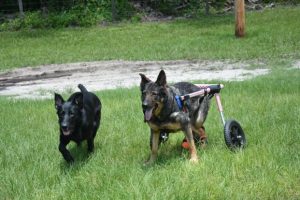
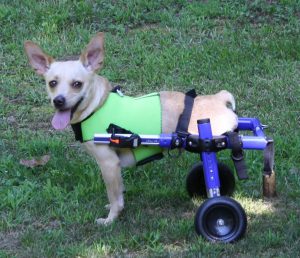
Then in 2008, HandicappedPets.com developed the Walkin’ Wheels wheelchair, an adjustable cart that required only one measurement, could ship the same day, and was affordable. With the advent of that wheelchair, pet owners had a clear option to euthanasia when a pet got injured, stricken with a disease, or was simply slowing down due to old age.
Rescue Organizations Often Help Those in the Greatest Need
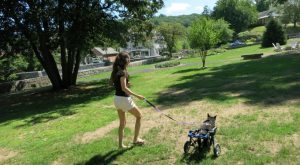
Sometimes dogs with the greatest physical needs wind up in the care of pet rescue organizations. Nine years ago, New Hampshire resident Courtney Dunning adopted a one-year-old disabled dog, Lucy, from a Puerto Rican rescue. The rescue had picked up Lucy after she was hit by a car, resulting in rear limb paralysis.
Lucy adapted extremely well to her dog wheelchair, and Courtney takes popping her in and out of it in stride. “It wound up being no harder than caring for any other dog,” says Courtney. “Lucy doesn’t know she’s different from other dogs. She’s just being a dog and loving life.”
Canine Mobility Challenges
German Shepherds, notorious for developing Degenerative Myelopathy, and Dachshunds, that have an estimated 25% incidence of intervertebral disc disease (IVDD), are among the breeds that are well loved but that suffer from a high rate of mobility challenges. But they are not alone; disease and injuries spare no breed, with resulting mobility impairments afflicting dogs of all ages.
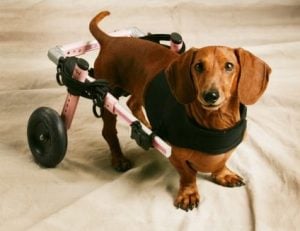
Carole Rowlette cares for 13 Dachshunds in her home in Wyoming. Three or four at a time are usually in dog wheelchairs. She advocates for the use of dog wheelchairs for rehab and strengthening, so leg muscles do not atrophy.
“If the dog is injured and gets laser therapy and acupuncture in time, they can often walk again, because you take the pressure off the legs,” says Carole.
More Widespread Use of Dog Wheelchairs Changing Views Worldwide
Greater accessibility to dog wheelchairs has resulted in a broadening awareness of this option, not only in the United States, but globally. Dog wheelchairs are no longer looked at as an oddity or luxury in many countries, but as a viable solution to help a pet stay mobile.
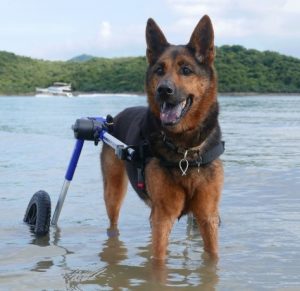
Hong Kong dog owners Nigel and Sandra Snell summarized this well in an article about their dog, Tessa, in the South China Morning Post:
“She [Tessa] still has this passion to be outdoors, so we decided it was up to us to make her mobile again.”
As dogs are increasingly viewed as family members in many cultures, as they are in the United States, pet owners are happy to discover available resources to extend their lives while preserving a high quality of life.
Types of Dog Wheelchairs
The most common dog wheelchairs are for pets with impairment in their rear legs. Typically, these carts have two wheels in the rear, with a frame that secures to the dog with a front harness.
Quad wheelchairs, also known as 4-wheel carts, help pets with weakness in their front legs, as well as in their rear legs. The assistance of a quad wheelchair enables them to stay mobile and continue to engage their muscles.
Other wheelchairs are made for pets that only have front leg challenges, but these are much less common.
[youtube https://www.youtube.com/watch?v=ndlRzUMjlYA?list=PLdOHEE4vvc8dOuqqn3FHtndL42xI_eH8_&w=560&h=315]
A dog wheelchair has become a practical and easy alternative to watching a pet become increasingly immobile and ultimately needing to make a decision about its quality of life. With mobility assistance, a dog can continue to enjoy running, playing, hiking, walking – essentially all the things it has always enjoyed doing.
In Home Pet Euthanasia Is An Option
And if you do reach a point where you need to let go, Petworks has in home pet euthanasia services available on call, throughout the United States.
***

Lisa G. Murray is a freelance writer and the Marketing & Public Relations Director of Walkin’ Pets by HandicappedPets.com, an online pet product company serving the needs of aging, disabled, and injured pets and their caretakers.
Additional links:
Walkin’ Pets on Petworks






 petworks tm