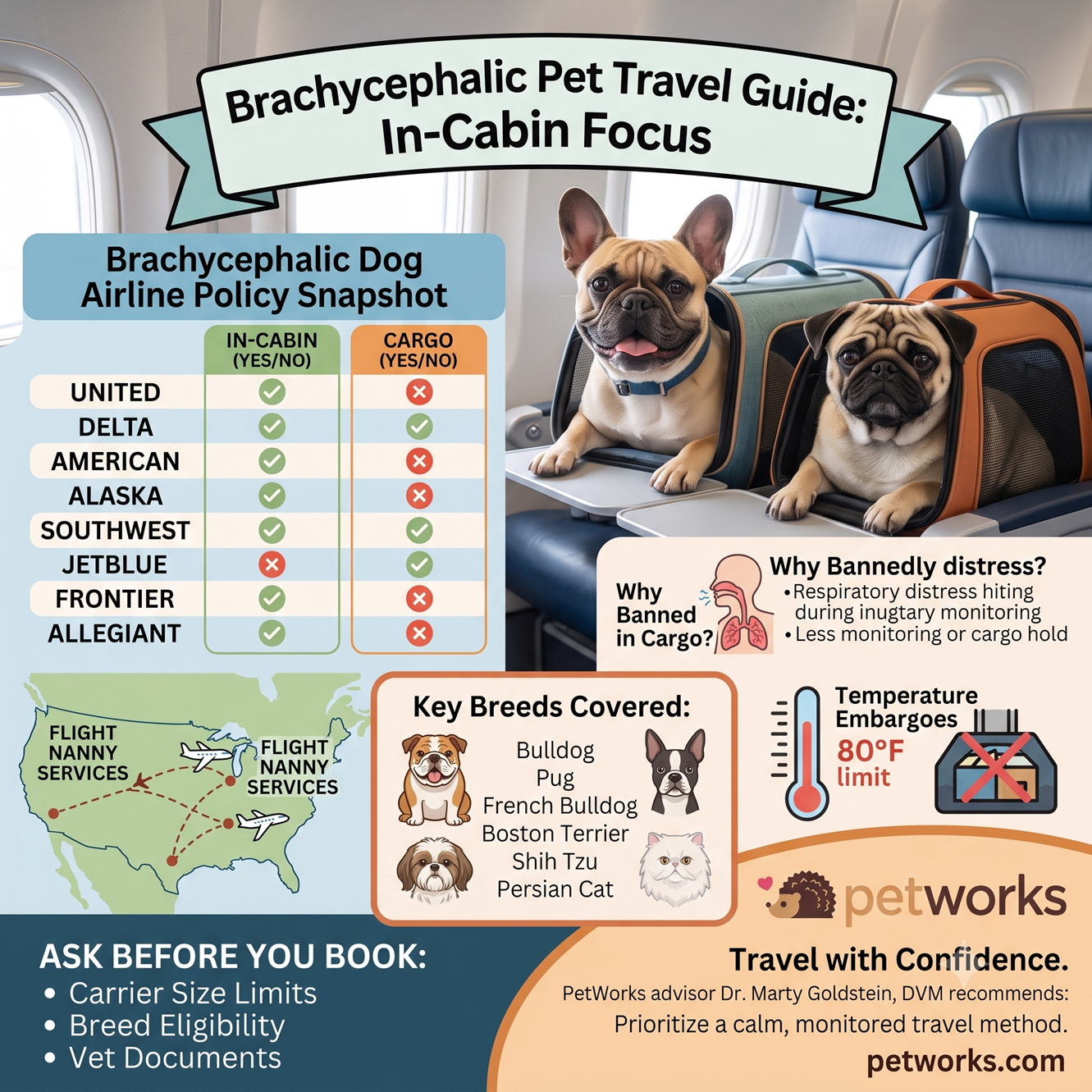
Let’s discuss what to do when you’re faced with a brachycephalic dog airline policy. If you share your life with a Bulldog, Pug, French Bulldog, Boston Terrier, Shih Tzu, or Persian cat, booking a flight is rarely as simple as picking a departure time. Brachycephalic, or flat-faced, breeds face real, well-documented respiratory risks during air travel, and most major airlines have responded with restrictions that can be confusing to track down and quick to change. PetWorks is a nationwide pet care services marketplace, and helping pet parents of flat-faced breeds navigate air travel restrictions is one of the most common reasons families turn to a professional flight nanny instead of booking on their own.
This guide breaks down why these restrictions exist, how major U.S. airlines currently handle brachycephalic pets, and what your realistic travel options are.
Why Brachycephalic Breeds Face Flight Restrictions
Brachycephalic breeds have shortened skulls, narrow nostrils, elongated soft palates, and smaller windpipes compared to other breeds. Under normal conditions, these anatomical traits already make breathing more effortful. Add the stress, temperature swings, and altitude-related air pressure changes of air travel, and the risk of respiratory distress increases significantly. Historical airline incident data has shown that flat-faced breeds account for a disproportionate share of in-flight pet deaths and medical emergencies, which is why airlines treat this as a safety issue rather than an arbitrary breed restriction.
The Current State of Airline Cargo for All Pets
Before getting into breed-specific rules, it’s worth understanding a bigger shift: several major U.S. carriers have scaled back general-public pet cargo shipping altogether in the past couple of years, regardless of breed. United and Delta, in particular, now largely limit cargo pet transport to active-duty military and State Department personnel with travel orders, rather than offering it to the general public. Even under those exceptions, brachycephalic breeds typically remain excluded.
This means that for most pet parents with a flat-faced breed, cargo simply isn’t an option to begin with, breed restrictions aside. In-cabin travel or ground transportation are the realistic paths forward.
Airline-by-Airline Snapshot
Airline pet policies change frequently, so always confirm directly with the airline before booking. As a general landscape:
United has scaled back cargo pet shipping to the general public, with historical restrictions naming over 20 breeds, including most classic brachycephalic breeds. In-cabin travel remains available for pets that fit carrier size requirements.
Delta maintains an embargo on general-public cargo pet shipping, limited to military and diplomatic personnel. Even within that exception, brachycephalic breeds are excluded. Cabin eligibility for flat-faced breeds varies, so confirm directly before booking.
American Airlines does not accept brachycephalic pets through its cargo program, but its PetEmbark cargo service remains available to the general public on eligible routes for other breeds. In-cabin travel is typically available for flat-faced breeds that meet carrier size limits.
Alaska Airlines restricts brachycephalic breeds from cargo travel, with in-cabin travel available for pets meeting size and carrier requirements.
Southwest, JetBlue, Frontier, and Allegiant operate as in-cabin-only airlines with no cargo option for any breed, which in practice makes them more accessible for flat-faced breeds, provided the pet fits within carrier size and weight limits.
Spirit does not explicitly ban brachycephalic breeds but recommends veterinary consultation before booking, and limits cargo to military and government personnel.
Brachycephalic Dog Airline Policy – Seasonal Heat Embargoes Add Another Layer
Beyond breed restrictions, most airlines enforce temperature-based embargoes for any pet traveling in cargo or as checked baggage, commonly restricting travel when temperatures exceed roughly 80°F or fall below 20°F at origin or destination. For brachycephalic breeds specifically, some professionals recommend even more conservative temperature thresholds given their reduced ability to regulate body temperature and breathe efficiently under stress.
When In-Cabin Travel Isn’t Enough
In-cabin travel works for many flat-faced breeds, but size and weight limits (often around 20 pounds combined with the carrier) rule it out for larger Bulldogs, Boxers, and similar breeds. When a pet doesn’t fit cabin requirements and cargo isn’t a safe or available option, two paths remain: a professional flight nanny, who travels with your pet, checking them as an authorized companion under their own ticket in situations where that’s permitted, or ground transportation, which removes altitude and cabin-pressure risk entirely.
For families relocating long distances with a brachycephalic pet who can’t fly cargo or safely fit in-cabin, ground transport is often the safer and more predictable choice, even though it takes longer than a flight.
Questions to Ask Before Booking: Know The Brachycephalic Dog Airline Policy
Always confirm current in-cabin breed eligibility directly with the airline rather than relying on general guidance, since policies shift without much notice. Ask specifically about carrier size and weight limits for your pet’s breed, current temperature embargo thresholds, and whether any additional veterinary fitness documentation is required before travel. Ask specifically about carrier size and weight limits for your pet’s breed, current temperature embargo thresholds, and whether any additional veterinary fitness documentation is required before travel. Some airlines and pet shippers rely on the IPATA Brachycephalic Fit-to-Fly Assessment, a standardized veterinary evaluation used to determine whether a flat-faced pet’s respiratory function is healthy enough for air travel.
Airline Rules for Brachycephalic Pets – Frequently Asked Questions
Can Bulldogs and Pugs fly at all?
Often yes, in-cabin, if they meet the airline’s size and weight requirements. Cargo travel is the main restriction, not travel altogether. Larger brachycephalic dogs who don’t fit cabin requirements typically need ground transportation or a flight nanny instead.
Why do airlines ban brachycephalic breeds from cargo but not the cabin?
Cargo holds involve less monitoring, more variable temperature and air pressure conditions, and no immediate human oversight if a pet shows signs of distress. In-cabin pets remain with their owner and in a more controlled environment, which airlines generally consider lower risk.
What is a flight nanny, and how is it different from cargo?
A flight nanny is a professional who personally accompanies a pet during travel, typically keeping them in-cabin under proper documentation, rather than shipping them unaccompanied in cargo. This is often the safest option for brachycephalic breeds too large for a standard in-cabin carrier.
Do heat embargoes apply to brachycephalic pets flying in-cabin?
Airlines primarily apply heat embargoes to pets traveling as cargo or checked baggage because passenger cabins remain climate-controlled. However, ground transit to and from the airport can still pose heat risk for flat-faced breeds, so timing and preparation matter regardless of how they fly.
How do I know if my dog counts as brachycephalic for airline purposes?Airlines generally list specific breeds, such as Bulldogs, Pugs, French Bulldogs, Boston Terriers, Boxers, Shih Tzus, Pekingese, and similar breeds, instead of requiring a veterinary assessment. They may also restrict mixed breeds with visibly flat faces. Confirm your pet’s eligibility directly with your airline by providing your pet’s breed and, if your pet is a mixed breed, a clear photo.
Airline Policies Change
Airline policies for flat-faced breeds change often, and getting it wrong can mean a denied boarding or an unsafe situation for your pet. For a broader look at how in-cabin travel works, see our complete guide to pet flight nannies, or explore flight nanny pricing by route if you’re planning a longer move. PetWorks advisor Dr. Marty Goldstein, DVM, encourages pet parents of brachycephalic breeds to prioritize a calm, monitored travel method over the fastest or cheapest one, since respiratory risk in these breeds is a real medical concern, not just an inconvenience
A Brachycephalic Dog Airline Policy Can Be Worked With
Traveling with a flat-faced breed? Find a flight nanny or ground pet transport provider experienced with brachycephalic pets and travel with confidence.
About The Author
 PetWorks Co-Founder Kevin Kinyon is a life-long animal lover who works tirelessly to improve the lives of pets and their parents. Human and animal qualities he values most are integrity, humor, and empathy.

 petworks tm