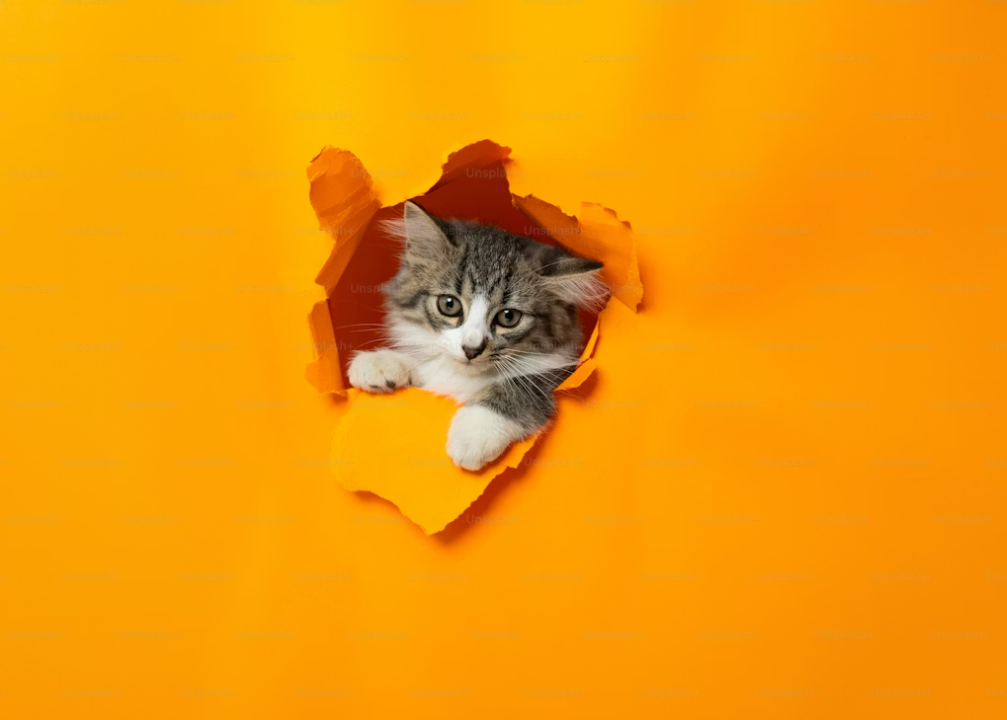
So why do cats stare at nothing? We share our homes with cats, yet they remain one of the most misunderstood animals on the planet. Their behaviors can seem random, aloof, or downright baffling — but modern animal behaviorists are revealing that there is sophisticated logic behind almost everything your cat does. From knocking objects off shelves to kneading your stomach at 2 a.m., feline behavior is a rich language that most owners have simply never been taught to read.
This article breaks down five of the most puzzling cat habits, explains what the science actually says, and gives you practical takeaways to better understand — and genuinely bond with — your cat.
1. The Blank Wall Stare: Your Cat Isn’t Hallucinating
Your cat is sitting perfectly still, pupils dilated, staring with laser intensity at a completely blank patch of wall. You check. Nothing is there. You check again. Still nothing. Then your cat casually walks away and demands a snack.
Before you call a pet psychic, consider the biology. Cats possess vision roughly six times more sensitive to motion in low-light conditions than humans. They can detect the micro-vibration of an insect inside a wall cavity or the faint movement of a spider descending a corner that your eye simply cannot register. Their hearing compounds this: cats can hear frequencies up to 64,000 Hz, compared to a human ceiling of around 20,000 Hz. Ultrasonic squeaks from rodents or insects behind drywall are, to your cat, a full and vivid sensory event.
Practical takeaway: If your cat regularly fixates on the same wall or corner, it may actually be signaling a pest problem worth investigating. Consider it a free home inspection — and take it seriously.
2. Knocking Things Off Tables: Cruelty or Curiosity?
Few cat behaviors have achieved such meme-worthy infamy as the deliberate, methodical push of an object off a surface while your cat maintains direct, unwavering eye contact with you. It feels passive-aggressive. It feels intentional. And in a sense, it is — just not in the way you think.
Cats are tactile investigators. Using their paws to bat at objects provides critical sensory data about texture, weight, and whether something might be alive. This is the same impulse that drives a cat to paw at prey to confirm it is dead before eating. When your cat swipes your phone off the nightstand, it is executing an instinctual assessment — not staging a rebellion.
There is also an attention dimension. Research in animal cognition confirms that cats are highly aware of cause-and-effect relationships between their actions and your reactions. If knocking over a glass previously brought you running, your cat has learned a reliable method for summoning you. Unintentionally, you trained it.
Practical takeaway: Provide puzzle feeders and interactive toys that satisfy your cat’s need to manipulate objects. The less enrichment a cat has, the more creative it gets with your belongings.
3. The 3 A.M. Zoomies: Wired, Not Weird
It is 3 a.m. Your cat sprints full-speed down the hallway, ricochets off the sofa, leaps onto your bed, stares at you for three unblinking seconds, then repeats the whole circuit. This phenomenon — known in veterinary circles as Frenetic Random Activity Periods, or FRAPs — is not a sign of madness.
Cats are crepuscular hunters, meaning they are evolutionarily wired for peak activity at dusk and dawn. Domestic life, however, compresses their world dramatically. An indoor cat that spends 18 to 20 hours resting accumulates a significant energy debt, and the body’s solution is a controlled explosion. FRAPs are also thought to serve as a release valve for built-up stress or overstimulation throughout the day.
Practical takeaway: A structured play session of 15 to 20 minutes before bedtime — using a wand toy that mimics natural prey movement — can significantly reduce or eliminate nighttime zoomies by depleting stored energy before it detonates at 3 a.m.

Are you finding this article useful? Would you like 100% free access to more articles like these, and free access to over 5,000 vetted pet care service professionals throughout the United States? Sign up here for a free PetWorks account, and we’ll email you a 10% discount code, good towards your first pet care services booking on PetWorks!
4. Slow Blinking: A Love Letter Written in Eye Contact
In the animal kingdom, sustained direct eye contact is typically a threat. Cats have quietly co-opted a subtle variation of this: the slow blink. When your cat holds your gaze and then deliberately, partially closes its eyes, it is extending what behaviorists recognize as a trust signal — the feline equivalent of saying, “I am so comfortable with you that I’m willing to lower my guard.”
A 2020 study published in Scientific Reports out of Portsmouth University formally validated what devoted cat owners had long suspected: cats are significantly more likely to approach humans who slow-blink at them, and they reciprocate the gesture more frequently with people who initiate it first. It is, in effect, a learnable handshake.
Dr. Mikel Delgado, a Certified Cat Behavior Consultant and researcher at UC Davis School of Veterinary Medicine, puts it plainly: “Many of the behaviors that frustrate cat owners are completely normal feline behaviors that are simply mismatched with a human environment. When owners understand what their cat is communicating, they can make changes that reduce stress for both the cat and themselves.”
Practical takeaway: You can actively deepen your bond — especially with a shy or newly adopted cat — by initiating slow blinks. Relax your face, soften your gaze, and close your eyes slowly. Then wait. Many cats will mirror you within seconds.
5. Chattering at Birds: The Sound of a Frustrated Hunter
You have almost certainly witnessed this: your cat crouches at the window watching a bird outside and begins producing a rapid, stuttering, mechanical-sounding clicking from its jaw — a vocalization unlike anything else in its repertoire. It looks involuntary. Sounds strange. It is completely fascinating.
The leading theory, supported by field researchers studying wild felids in the Amazon, is that this chattering mimics the “kill bite” — a rapid, precise neck bite cats use to dispatch prey. The behavior appears to be an involuntary motor response triggered by predatory arousal when prey is visible but completely unreachable. It is the sound of instinct colliding with a glass window.
Some researchers also suggest the chattering may function as a form of prey mimicry — wild cats have been observed making similar sounds to lure curious birds or primates closer. Your living room cat may be running an ancient hunting subroutine it has never had the opportunity to complete.
Practical takeaway: Chattering is a sign your cat has strong, healthy predatory drive that needs an outlet. Window bird feeders are wonderful enrichment tools — just be sure to follow them up with a daily wand-toy play session so your cat gets to experience the full hunt cycle: stalk, chase, catch, and reward.
The Bigger Picture: Behavior Is Communication
Every strange thing your cat does is a data point. Cats did not evolve to live in apartments with Wi-Fi and dry kibble — they evolved as solitary, highly efficient predators in complex environments. When we understand that context, the “weird” behaviors stop seeming weird and start seeming like exactly what they are: a highly adapted animal doing its best to express its needs in a world it did not design.
The more fluent you become in your cat’s behavioral language, the more responsive and enriching an owner you become — and the more content, less stressed, and genuinely happier your cat will be.
Frequently Asked Questions
Q: Why does my cat stare at me while I sleep? Cats are light sleepers and remain alert even at rest. Watching you while you sleep is a monitoring behavior — your cat is keeping tabs on the most important resource in its environment: you. It can also reflect affection, as cats often orient toward the people they feel safest with.
Q: Is it normal for cats to suddenly run around for no reason? Yes, completely. Frenetic Random Activity Periods (FRAPs or “zoomies”) are a normal outlet for accumulated energy, especially in indoor cats. If it happens frequently, it is a signal your cat needs more structured daily playtime.
Q: Why does my cat knock things over even when it doesn’t seem to want attention? Not all object-knocking is attention-seeking. Much of it is tactile exploration and predatory play behavior. Providing appropriate outlets — toys with different textures, puzzle feeders, foraging activities — tends to reduce the behavior noticeably.
Q: What does it mean when a cat slowly blinks at you? It is widely recognized by animal behaviorists as a relaxed trust signal. Returning the slow blink is one of the simplest and most effective ways to communicate comfort and safety to your cat.
Q: Why does my cat chatter but only at certain animals — like birds or squirrels — and not others? Chattering appears to be specifically triggered by small, fast-moving prey animals that activate the predatory sequence. It is an involuntary response to the combination of visual stimulation and the frustration of being unable to complete the hunt.
Q: Should I be worried if my cat’s weird behaviors suddenly change or increase? Yes — a sudden change in behavior, including new or intensified quirks, can sometimes indicate an underlying health issue. If your cat’s behavioral patterns shift noticeably without an obvious environmental cause, a vet visit is always the right call.
About PetWorks
 In 2021, Dr. Marty Goldstein DVM joined the pet care platform PetWorks as an advisor in its Animal Nutrition care division. Dr Marty Nature’s Blend is on a mission to help your pets live their healthiest lives possible. Dr. Marty’s pet nutrition expertise and guidance has helped PetWorks evolve and become the preeminent animal and pet nutrition consultation service for pet parents in North America.
 In 2022, Blue Buffalo Founder Bill Bishop Jr. joined PetWorks as Senior Advisor in our Animal Nutrition Care Division. Bill brings his extensive expertise in pet food innovation and business leadership. His guidance helps PetWorks enhance our pet nutrition service offerings, helping to ensure that pet parents throughout the world receive trusted, science-backed nutritional support for their dogs, cats, and animals.
About The Author
 PetWorks Co-Founder Kevin Kinyon is a life-long animal lover who works tirelessly to improve the lives of pets and their parents. Human and animal qualities he values most are integrity, humor, and empathy.

 petworks tm