Moving day is one of the most chaotic days in any household. Doors get propped open. Strangers come in and out. Routines disappear. Furniture gets rearranged. For a pet, all of this adds up to a perfect storm of confusion and stress, and for some animals, that stress leads to a split-second escape that can turn an already demanding day into a crisis.
A pet going missing during a relocation is more common than most people expect. Dogs bolt through open front doors. Cats squeeze through gaps in moving boxes stacked near windows. Even calm, well-behaved animals can behave unpredictably when their environment is suddenly unrecognizable.
If your pet has gone missing during a move, or if you want to make sure it never happens to you, this guide walks through exactly what to do, step by step.
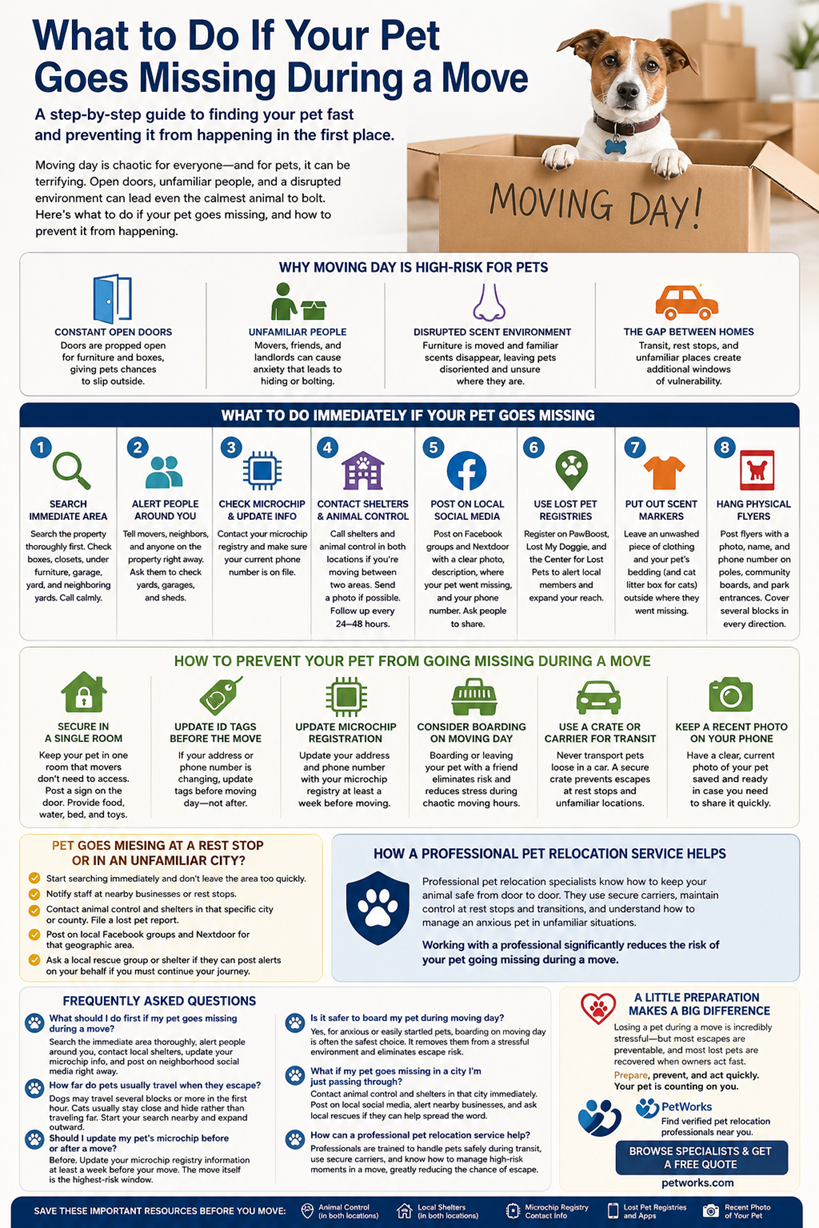
Why Moving Day Is One of the Highest-Risk Times for a Pet to Go Missing
Understanding why pets escape during relocations helps you take the right precautions before the move begins. Several factors combine to make moving day unusually dangerous for animals.
Constant open doors
During a move, the front door is often propped open for extended periods while furniture and boxes are carried out. This gives a dog or cat multiple opportunities to slip outside unnoticed, especially when attention is divided among movers, boxes, and logistics.
Unfamiliar people in the home
Most pets are accustomed to a predictable household. The sudden presence of movers, friends helping with the move, or landlords doing a walkthrough can cause anxiety that leads to hiding, bolting, or seeking an exit.
Disrupted scent environment
Pets navigate their world largely through smell. When furniture is moved, rooms are emptied, and familiar scents disappear, animals can become genuinely disoriented. A dog or cat that escapes during this phase may struggle to find their way back because the environment no longer smells like home.
The gap between old home and new
If you are making multiple trips between your old and new home, or if there is a period where your pet is in transit, there is an additional window of vulnerability at rest stops, parking areas, and unfamiliar outdoor spaces where an anxious animal may bolt.

Are you finding this article useful? Would you like 100% free access to more articles like these, and free access to over 5,000 vetted pet care service professionals throughout the United States? Sign up here for a free PetWorks account, and we’ll email you a 10% discount code, good towards your first pet care services booking on PetWorks!
What to Do Immediately If Your Pet Goes Missing During a Move
If your pet has escaped or gone missing during a relocation, act quickly. The first few hours are the most important.
Step 1: Stop and search the immediate area first
Before expanding your search, search the property thoroughly. Cats in particular will often hide in small, enclosed spaces nearby rather than running far. Check inside boxes, under furniture that has not yet been moved, in closets, behind appliances, in the basement or garage, and in any area of the home that still has familiar scent. Dogs may have run into the yard or a neighboring yard. Call their name calmly rather than frantically, as a panicked tone can cause a frightened animal to hide further.
Step 2: Alert the people around you immediately
Tell your movers, neighbors, and anyone else on the property right away. The more eyes searching in the first few minutes, the better. Ask neighbors to check their yards, garages, and sheds. Give them a clear description and your phone number.
Step 3: Check for microchip registration and update your contact information
If your pet is microchipped, contact the microchip registry immediately and make sure your current phone number is on file. If you have already changed your address or phone number for the move, update it now. A microchipped pet that is found and scanned at a shelter or vet clinic can only be reunited with you if your contact information is current.
Step 4: Contact local shelters and animal control in both locations
If you are mid-move between two cities or towns, contact animal control and shelters in both areas. Describe your pet clearly, including breed, size, color, distinguishing marks, collar color, and any behavioral traits that would help someone identify them. Ask if you can email a photo. Follow up by phone every 24 to 48 hours rather than waiting for them to call you.
Step 5: Post on local Facebook groups and Nextdoor immediately
Neighborhood social media platforms are often the fastest way to surface a lost pet. Post a clear photo, a physical description, the location where the pet went missing, and your phone number. Ask people to share the post. In many cases, a neighbor has already spotted the animal and will respond within minutes.
Step 6: Use lost pet registries and apps
Register your missing pet on dedicated lost pet platforms such as PawBoost, Lost My Doggie, and the Center for Lost Pets. These services alert local members and can significantly expand your reach beyond your immediate neighborhood network.
Step 7: Put out familiar scent markers
Leave an unwashed piece of your clothing and your pet’s bedding near the location where they went missing. Familiar smells can help a disoriented animal find their way back, especially dogs. If you have a cat, some experts recommend placing their used litter box outside, as the strong scent can act as a beacon.
Step 8: Hang physical flyers in the area
Print flyers with a clear photo, your pet’s name, a physical description, and your phone number. Post them at eye level on telephone poles, community boards, and at the entrances to any nearby parks. Cover a radius of at least several blocks in every direction from where the pet went missing.
How to Prevent Your Pet From Going Missing During a Move
Prevention is far easier than recovery. These steps will significantly reduce the risk of your pet escaping during a relocation.
Secure your pet in a single room before moving begins
On moving day, confine your pet to one room that movers will not need to access. Put a sign on the door asking people not to open it. Keep food, water, their bed, and a familiar toy in the room with them. Check on them periodically but limit disruption.
Update ID tags before the move, not after
If you are moving to a new address or getting a new phone number, update your pet’s ID tags before moving day. This is one of the most commonly overlooked steps in pet relocation preparation. A pet found by a stranger can only be returned to you if the tag information is current.
Update microchip registration before the move
Contact your microchip registry and update your address and phone number at least a week before your move date. Do not wait until you are settled in the new home. The gap during transit is when you are most vulnerable.
Consider boarding your pet on moving day
If you have a dog that is prone to anxiety or bolting, or a cat that is highly reactive to strangers, consider boarding them at a trusted facility or leaving them with a friend or family member for the duration of moving day. This removes the risk entirely and reduces stress for the animal.
Use a crate or carrier for transit
When transporting your pet between your old and new home, use a secure crate or carrier. Never transport a dog or cat loose in a car during a move, as a single opened door at a rest stop is all it takes for a frightened animal to escape in an unfamiliar location far from home.
Keep a recent, clear photo of your pet on your phone
This sounds simple but many pet owners do not have a current, high-quality photo readily available when they need it. Before your move, take a clear photo of your pet from the front showing their face, markings, and size. Store it somewhere you can access it instantly.
What to Do If Your Pet Goes Missing at a Rest Stop or in an Unfamiliar City
If your pet escapes during transit, such as at a rest stop, gas station, or unfamiliar location mid-route, the situation is more complex because you are far from your home base and possibly far from your destination.
Start searching immediately and do not leave the area too quickly. A frightened animal will often stay close to where they escaped, especially in the first hour. Notify the staff at any nearby business or rest stop facility so they can watch for the animal after you have gone.
Contact the nearest animal control office and shelters in that specific town or county, not just the ones near your origin or destination. File a lost pet report with that local authority. Post on local Facebook groups and Nextdoor for that specific geographic area rather than your home community.
If you cannot stay in the area, ask a local animal rescue group or shelter if they can post alerts on your behalf. Some regions have volunteer networks specifically for lost pets in transit situations.
Working With a Professional Pet Relocation Service Reduces This Risk Significantly
One of the most effective ways to prevent a pet from going missing during a move is to work with a professional pet relocation service from the start. Professional pet relocation coordinators handle the logistics of moving your animal safely from your old home to your new one, including secure transport, proper containment, and experienced handling that accounts for an animal’s stress responses during unfamiliar situations.
A professional who specializes in pet relocation has transported dozens or hundreds of animals and knows where the highest-risk moments are in the process. They use secure carriers, maintain control at rest stops and transitions, and know how to manage an anxious animal in a way that minimizes the chance of escape.
PetWorks connects pet families with verified, reviewed pet relocation professionals across the country. You can browse pet relocation specialists here and get a free quote before your move date.
Frequently Asked Questions: Lost Pets During a Move
What should I do first if my pet goes missing during a move?
Search the immediate property thoroughly before expanding your search. Pets, especially cats, often hide nearby rather than running far. Check inside boxes, under furniture, in closets, and in any enclosed spaces. Then alert everyone on the property and neighbors, contact local shelters, and post on neighborhood social media immediately.
How far do pets usually travel when they escape during a move?
It depends on the animal and the circumstances. Dogs may cover several blocks or more within the first hour, particularly if they are running in a panic. Cats more often stay within a close radius and hide rather than travel, sometimes within the same property or a neighboring yard. Either way, starting your search close and expanding outward is the right approach.
Should I update my pet’s microchip before or after a move?
Before. Update your microchip registry information at least one week before your move date. The period during the move itself is one of the highest-risk times for a pet to go missing, and you want your current contact information on file before that window opens.
Is it safer to board my pet during moving day?
For pets that are prone to anxiety, easily startled, or have a history of bolting, boarding on moving day is often the safest choice. It removes the animal from a high-stress environment entirely and eliminates the risk of escape during the hours when doors are constantly open and attention is divided.
What if my pet goes missing in a city I am just passing through?
Contact animal control and shelters in that specific city or county right away. Post on Nextdoor and local Facebook groups for that geographic area. Leave your contact information with nearby businesses. If you cannot stay in the area, reach out to local rescue organizations who may be able to post alerts on your behalf and watch for your pet after you have had to continue your journey.
How can a professional pet relocation service help prevent a pet from getting lost?
Professional pet relocation specialists are trained to manage animals safely during transit. They use secure carriers, know how to handle anxious animals at rest stops and transition points, and have experience with the moments in a move that carry the highest risk of escape. Hiring a professional significantly reduces the chance of a pet going missing compared to managing the process alone on a chaotic moving day.
What lost pet resources should I know about before I move?
Before your move, save the contact information for animal control in both your origin and destination cities. Register on the Center for Lost Pets database. Make sure your microchip registry account is active and your contact details are current. Having these resources ready before an emergency means you can act in the first minutes after a pet goes missing rather than spending that time searching for phone numbers. God forbid your pet gets lost, PetWorks has missing pet finders on call.
A Little Preparation Makes a Big Difference
Losing a pet during a move is one of the most stressful things that can happen in an already demanding process. The good news is that most escapes are preventable with a small amount of preparation, and most lost pets are recovered when their owners act quickly and use the right channels.
Secure your pet before moving day begins. Update their tags and microchip registration beforehand. Have a current photo ready. And if the logistics of your move feel overwhelming, consider working with a professional who handles pet relocation every day and knows how to keep your animal safe from door to door.
PetWorks makes it easy to find a verified pet relocation professional near you. Browse specialists and get a free quote here.
About The Author
 PetWorks Co-Founder Kevin Kinyon is a life-long animal lover who works tirelessly to improve the lives of pets and their parents. Human and animal qualities he values most are integrity, humor, and empathy.

 petworks tm