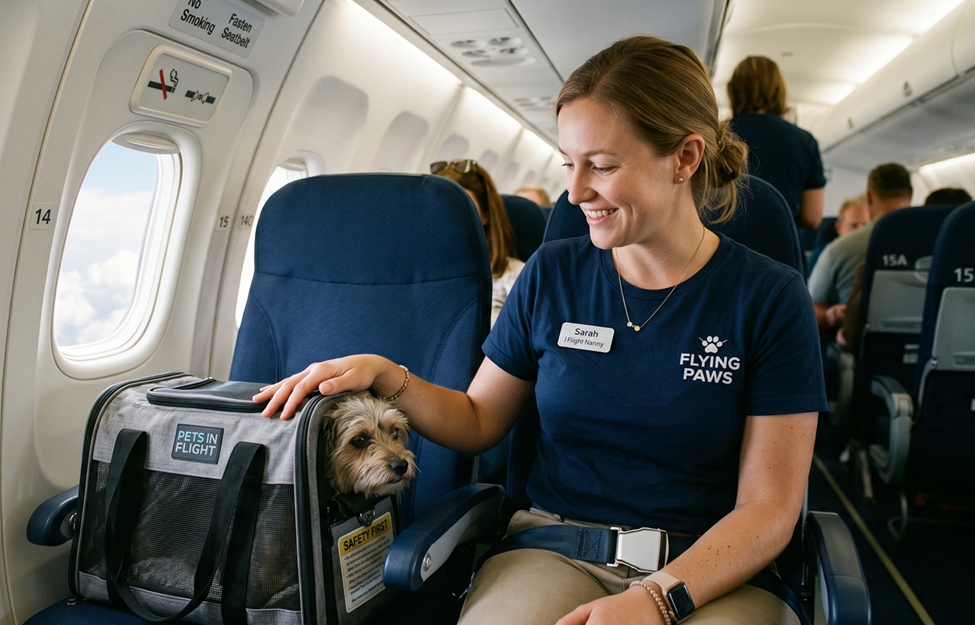
If you have been searching for a safe, hands-on way to transport your dog or cat by air, you have probably come across the term “pet flight nanny.” But one of the most common questions pet parents ask is: where exactly do pet flight nannies fly, and can they cover my route?
The short answer is: almost anywhere a commercial airline goes. But the longer answer is worth understanding, because routes, airline policies, and logistics vary in ways that directly affect how your pet travels and what it costs.
This guide breaks down the most popular domestic and international routes that pet flight nannies cover, what to expect on each type of trip, and how to find a flight nanny on PetWorks who serves your specific corridor.
What Is a Pet Flight Nanny, and Why Does the Route Matter?
A pet flight nanny is a professional animal handler who travels with your pet in the airline cabin as a personal escort. Rather than placing your pet in cargo or arranging a separate transport service, a flight nanny sits alongside your dog or cat from departure to arrival, managing feeding, comfort, and any in-flight needs.
The route matters for several reasons:
- Airline pet policies vary by carrier, and not all airlines allow in-cabin pets on every route
- International flights add customs paperwork, health certificate timelines, and country-specific entry rules
- Flight duration affects how the trip is structured, whether a nanny books a direct flight or a connection
- Hub airports affect availability, since most flight nannies operate out of major cities
Understanding the route your pet will travel helps you ask the right questions, set expectations, and budget accurately.
“Around 780,000 pets are transported by plane every year, and flight nannies are becoming an increasingly popular option.” – PetWorks Co-Founder Kevin Kinyon
Popular Domestic Pet Flight Nanny Routes in the United States
Pet flight nannies in the U.S. work primarily on commercial domestic routes, flying in-cabin with pets that meet airline size requirements. The routes below represent the highest-demand corridors based on where PetWorks flight nannies are most frequently booked.
East Coast to West Coast Routes
Long-haul transcontinental routes are among the most requested for pet flight nannies. Pet parents relocating, adopting from out-of-state breeders, or moving for work commonly use flight nanny services on these corridors.
High-demand routes include:
- New York (JFK / LGA / EWR) to Los Angeles (LAX / BUR)
- New York to San Francisco (SFO / OAK)
- Boston (BOS) to Los Angeles or Seattle (SEA)
- Washington D.C. (DCA / IAD / BWI) to Los Angeles or Portland (PDX)
- Atlanta (ATL) to San Francisco or Seattle
These routes typically run four to six hours nonstop, which is manageable for most small dogs and cats traveling in-cabin. Flight nannies on transcontinental routes focus heavily on pre-flight hydration, crate acclimation, and selecting carriers with reliable pet-friendly policies.
Southeast and Sun Belt Routes
Florida is one of the busiest states for pet flight nanny bookings, particularly for pet parents moving to or from the Northeast or Midwest, or adopting puppies from breeders in the South.
Common Southeast routes include:
- Miami (MIA) to New York, Chicago (ORD / MDW), or Boston
- Orlando (MCO) to New York or Washington D.C.
- Tampa (TPA) to Chicago or Philadelphia (PHL)
- Charlotte (CLT) to Los Angeles or Dallas (DFW)
- Nashville (BNA) to New York or San Francisco
The Southeast also sees heavy traffic for puppy transportation, with breeders in Georgia, Tennessee, and the Carolinas frequently using flight nannies to deliver puppies to families across the country.
Midwest to Coastal Routes
Pet parents in the Midwest often rely on flight nannies when driving is impractical or when timing is tight, such as with a new puppy delivery or a last-minute relocation.
Frequently booked Midwest routes include:
- Chicago (ORD) to Los Angeles, Miami, or New York
- Denver (DEN) to Chicago, Atlanta, or Seattle
- Dallas (DFW) to New York, Boston, or Los Angeles
- Minneapolis (MSP) to Miami or New York
- Kansas City (MCI) to Los Angeles or Atlanta
Texas Hub Routes
Texas is a particularly active market for pet flight nannies because of the state’s size and its role as a major airline hub. Pet parents in Texas often need flight nannies to cover routes that would otherwise require a full day of driving.
Active Texas routes include:
- Houston (IAH / HOU) to New York, Chicago, or Los Angeles
- Austin (AUS) to Los Angeles, San Francisco, or Boston
- Dallas (DFW) to Miami, Seattle, or Washington D.C.
Pacific Northwest and Mountain West Routes
- Seattle (SEA) to New York, Chicago, or Atlanta
- Portland (PDX) to Dallas or Miami
- Phoenix (PHX) to Chicago, New York, or Atlanta
- Las Vegas (LAS) to New York or Miami

Are you finding this article useful? Would you like 100% free access to more articles like these, and free access to over 5,000 vetted pet care service professionals throughout the United States? Sign up here for a free PetWorks account, and we’ll email you a 10% discount code, good towards your first pet care services booking on PetWorks!
International Pet Flight Nanny Routes
International pet flight nanny service adds meaningful complexity compared to domestic routes. In addition to the in-cabin care your pet receives, a flight nanny coordinating international travel will typically help you navigate health certificate requirements, microchip documentation, and destination-country entry rules.
Note that some international routes require pets to travel in the cabin of a connecting U.S. domestic leg, then transfer to a cargo-compliant international carrier. The flight nanny’s role, scope, and any handoff arrangements should be discussed clearly before booking.
United States to Canada
Canada is one of the most accessible international destinations for pet flight nannies. Entry requirements are relatively straightforward for dogs and cats traveling from the U.S., though documentation is still required.
Common U.S. to Canada routes:
- New York to Toronto (YYZ) or Montreal (YUL)
- Chicago to Toronto or Vancouver (YVR)
- Seattle to Vancouver
- Miami to Toronto
- Los Angeles to Vancouver or Calgary (YYC)
United States to Mexico and the Caribbean
Mexico and popular Caribbean destinations see strong seasonal demand, particularly from pet parents relocating to beach communities or snowbirds who travel with their animals.
Common routes include:
- Dallas or Houston to Mexico City (MEX) or Cancun (CUN)
- Miami to Havana, Nassau, or San Juan (SJU)
- Los Angeles to Puerto Vallarta (PVR) or Cabo San Lucas (SJD)
- New York to San Juan, Puerto Rico
Puerto Rico is a U.S. territory, which simplifies the process considerably for pet parents used to navigating international requirements.
United States to Europe
Transatlantic routes are where pet flight nanny coordination becomes most nuanced. Most major European carriers allow small pets in-cabin on transatlantic flights, though policies differ by airline and destination country. The EU has clear entry requirements around microchipping, rabies vaccination timing, and tapeworm treatment for dogs entering certain member states.
Common U.S. to Europe routes for pet flight nannies:
- New York (JFK) to London (LHR / LGW), Paris (CDG), or Amsterdam (AMS)
- Boston to London or Dublin (DUB)
- Chicago to Frankfurt (FRA) or Zurich (ZRH)
- Miami to Madrid (MAD) or Lisbon (LIS)
- Washington D.C. to Rome (FCO) or Barcelona (BCN)
- Los Angeles to London or Paris
Pet parents should plan European trips with significant lead time, as some countries require health certificates issued within a very specific window before travel.
United States to Asia and Australia
Routes to Asia and Australia are among the most complex for pet transport. Many Asian carriers restrict in-cabin pets entirely, and Australia has some of the strictest biosecurity requirements in the world, typically requiring extended quarantine periods regardless of how the animal travels.
A flight nanny traveling with a pet toward Australia or New Zealand should be understood as managing the U.S. departure leg and handoff process, as the destination-country arrival may involve quarantine facilities that are outside any nanny’s scope of service.
Routes where flight nannies assist pet parents:
- Los Angeles or San Francisco to Tokyo (NRT), Seoul (ICN), or Hong Kong (HKG)
- Seattle to Tokyo or Singapore (SIN)
- New York or Chicago to Dubai (DXB) as a connection hub
For travel to Asia and Australia, pet parents should also consider working with a dedicated international pet shipper for the destination-country leg. Petworks has a separate category of vetted international pet shipping professionals for this purpose.
United States to Latin America
Latin American routes vary significantly by country in terms of airline pet policies and entry requirements.
Common Latin America routes:
- Miami to Bogota (BOG), Lima (LIM), or Buenos Aires (EZE)
- New York or Miami to Sao Paulo (GRU) or Rio de Janeiro (GIG)
- Houston to Panama City (PTY) or San Jose, Costa Rica (SJO)
- Los Angeles or Miami to Santiago (SCL), Chile
Which Airlines Do Pet Flight Nannies Use?
Pet flight nannies book on airlines that allow small pets to travel in-cabin, where the animal fits in an approved carrier under the seat in front of the nanny. The most commonly used airlines for domestic U.S. pet flight nanny trips include:
- American Airlines – allows in-cabin pets on most domestic routes
- Delta Air Lines – allows in-cabin pets on domestic and some short international routes
- United Airlines – PetSafe program and in-cabin options depending on route
- Southwest Airlines – allows in-cabin pets on domestic routes, no international service
- Alaska Airlines – strong pet-friendly reputation on domestic and limited international routes
- JetBlue – allows in-cabin pets on many domestic routes
- Frontier Airlines – in-cabin pet option on domestic routes
For international travel, flight nannies may book on U.S. carriers for the domestic portion and coordinate with international carriers such as Lufthansa, British Airways, Air France, Iberia, or KLM depending on the destination.
Airline policies change, and it is always worth confirming the current in-cabin pet policy for your specific route before booking.
Here is the new pricing section, ready to drop into the article. You can place it just before the “How to Find a Pet Flight Nanny” section.
Average Pet Flight Nanny Costs by Route in 2026
Pricing for pet flight nanny service is not one-size-fits-all. Every quote reflects the nanny’s service fee, the cost of their airfare, the airline’s in-cabin pet fee (typically $95 to $150 each way), and any incidentals like ground transportation or overnight stays. The figures below represent typical all-in ranges pet parents are seeing in 2026, based on current market rates across the industry.
Domestic U.S. Routes
Miami (MIA) to New York (JFK/LGA) Approximate range: $800 to $1,100 This Southeast-to-Northeast corridor is one of the most frequently booked domestic routes. Nonstop flights run about three hours, making it a manageable same-day trip. Airfare for the nanny is moderate, and same-day delivery is commonly available.
Dallas (DFW) to Chicago (ORD) Approximate range: $750 to $1,000 A solid mid-distance route with strong nonstop flight options. The two-and-a-half to three hour flight keeps nanny time and airfare costs reasonable, and Chicago’s O’Hare is a well-served hub with plenty of scheduling flexibility.
Los Angeles (LAX) to New York (JFK) Approximate range: $1,100 to $1,500 Transcontinental routes carry the highest domestic price tags. The five-plus hour flight means a long commitment for the nanny, and cross-country airfare adds meaningful cost. That said, this is one of the most requested routes in the country and well-covered by experienced nannies.
Atlanta (ATL) to Boston (BOS) Approximate range: $850 to $1,150 A popular route for families relocating along the East Coast and for breeders in the Southeast delivering puppies to New England homes. Good nonstop availability keeps the trip relatively efficient.
Houston (IAH/HOU) to Seattle (SEA) Approximate range: $1,000 to $1,400 This longer domestic route often requires a connection, which adds both time and cost. In-cabin pet fees apply on each segment, and the nanny’s travel day can stretch to ten or more hours. Pet parents on this corridor should book at least three to four weeks in advance for best pricing.
International Routes
New York (JFK) to London (LHR) Approximate range: $1,800 to $2,800 Transatlantic routes are the most complex and most expensive. Beyond the nanny’s international airfare, pet parents must account for the UK’s specific entry requirements, which include microchip verification, rabies vaccination documentation, and a health certificate issued and endorsed within a set window before travel. The nanny’s travel day is typically 10 to 14 hours including layovers and transfer time.
Miami (MIA) to Toronto (YYZ) Approximate range: $1,000 to $1,500 Canada is one of the more accessible international destinations for pet travel. Documentation requirements are straightforward compared to Europe or Asia, and flight times are short. This makes the Miami-to-Toronto route one of the more approachable international options, though the international airfare still pushes costs above domestic rates.
Los Angeles (LAX) to Mexico City (MEX) Approximate range: $1,100 to $1,600 Mexico routes are popular among pet parents relocating to major cities or resort communities. Nonstop flight time is roughly three hours, but international coordination, health certificate endorsement, and import documentation add to the overall cost and planning timeline.
Dallas (DFW) to San Jose, Costa Rica (SJO) Approximate range: $1,400 to $2,000 Latin American routes like Costa Rica carry higher costs because of limited nonstop options, longer travel days, and destination-country paperwork requirements. Costa Rica requires a health certificate, proof of vaccination, and a SENASA import permit, all of which add lead time and coordination to the booking.
Chicago (ORD) to Frankfurt (FRA) Approximate range: $2,200 to $3,200 One of the more demanding international routes in terms of planning and cost. EU entry requirements are detailed, and Germany specifically requires documentation that is properly timed and endorsed. The nanny’s round-trip international airfare is a significant component of the total cost, and overnight stays may be required depending on scheduling.
A note on these estimates: Costs generally cover the nanny’s service fee, while airline pet fees and ticket charges depend on carrier policies. All-in pricing can shift based on how far in advance you book, whether the route requires a connection, the pet’s size and breed, and the individual nanny’s rates. Brachycephalic breeds like French Bulldogs and Pugs may incur extra charges due to potential health risks during air travel. The best way to get an accurate number for your specific route is to request a free quote directly through PetWorks, where you can compare verified nannies and their pricing side by side.
What Affects the Cost of a Pet Flight Nanny Route?
Route length and complexity are among the biggest cost drivers for pet flight nanny service. Here is how different route types tend to affect pricing:
Short domestic routes (under two hours) are generally the most affordable. Routes like Boston to New York, Dallas to Houston, or Miami to Orlando are often booked for same-day roundtrip service.
Transcontinental routes (four to six hours) represent the middle tier. The flight nanny’s airfare is higher, the time commitment is longer, and the booking lead time is typically greater.
International routes carry the highest cost because of airline ticket prices, longer travel days, the potential need for overnight stays, and the additional coordination involved in documentation and customs.
Pet size matters too, but primarily in relation to airline requirements. Most in-cabin pets must weigh under 20 pounds including the carrier, which limits the service to small dogs, cats, and similarly sized animals.
For a full breakdown of pet transportation pricing, see our detailed pet transportation cost guide.
How to Find a Pet Flight Nanny for Your Route on PetWorks
PetWorks connects pet parents with vetted, reviewed flight nannies across the country. When browsing listings, you can search by your departure city and filter by nannies who have experience with your destination.
Here is what to look for when reviewing a flight nanny profile for your specific route:
- Experience flying the specific corridor you need, or comfort with the airports involved
- Familiarity with airline policies at your departure hub
- Reviews from pet parents who have used the nanny for similar distance trips
- Clear communication about what documentation they will help coordinate
- A stated policy on what happens if a flight is delayed, cancelled, or rebooked
Find and book a pet flight nanny near you on PetWorks and read verified reviews from real pet parents who have used the service.
FAQ: Pet Flight Nanny Routes
What routes do pet flight nannies cover? Pet flight nannies cover virtually any route a commercial airline serves, including domestic U.S. routes and many international destinations. The most commonly booked domestic corridors include East Coast to West Coast routes, Southeast to Northeast routes, and Texas to coastal city routes. Internationally, Canada, Mexico, the Caribbean, and Europe are the most active markets.
Can a pet flight nanny fly internationally? Yes, pet flight nannies can fly internationally, though international routes require additional planning. Health certificates, microchip verification, rabies documentation, and destination-country entry requirements all need to be arranged in advance. Some countries also require tapeworm treatment for dogs. The complexity and lead time involved increase significantly for international bookings compared to domestic travel.
What is the most common domestic pet flight nanny route? Transcontinental routes between the East Coast and West Coast are among the most frequently booked for pet flight nannies. New York to Los Angeles, Boston to San Francisco, and Washington D.C. to Seattle are all high-demand corridors. Southeast-to-Northeast routes, particularly from Florida cities to New York or Chicago, are also very common.
Do pet flight nannies fly to Europe? Yes, pet flight nannies assist with U.S. to Europe travel, particularly for small dogs and cats that qualify for in-cabin transport on transatlantic routes. New York to London, Boston to Dublin, and Miami to Madrid are common examples. EU entry requirements include a valid microchip, rabies vaccination, and a health certificate issued within a specific window before departure.
Which airlines allow pet flight nannies to bring pets in-cabin? American Airlines, Delta, United, Southwest, Alaska Airlines, JetBlue, and Frontier all allow small pets in the cabin on many domestic routes. For international travel, airlines such as Lufthansa, British Airways, Air France, and Iberia allow in-cabin pets on some transatlantic routes. Policies vary by route and are subject to change, so confirming directly with the airline before booking is always recommended.
How far in advance should I book a pet flight nanny? For domestic routes, booking two to four weeks in advance is generally recommended to allow time for health certificate coordination and flight planning. For international routes, especially those to the EU or to countries with strict biosecurity requirements, booking six to eight weeks in advance is advisable. Some destination countries require health certificates issued within a narrow window before arrival, which makes timing critical.
Is a pet flight nanny different from pet cargo shipping? Yes. A pet flight nanny travels with your pet in the airline cabin as a personal escort. Your pet rides under the seat in front of the nanny in an approved carrier, in the same cabin as passengers. Cargo shipping places pets in a pressurized but separate cargo hold. Flight nanny service is a hands-on, in-cabin option for smaller pets, while cargo and freight-based services are typically used for larger animals or situations where in-cabin travel is not possible.
Can a pet flight nanny transport a puppy? Yes, pet flight nannies frequently transport puppies, particularly for families adopting from breeders in other states. Puppies must meet minimum age requirements for air travel, which vary by airline but are typically eight weeks at minimum, and some airlines require older minimums. Health certificates and veterinary sign-off are required. PetWorks has a robust community of nannies experienced with puppy transport across the country.
What happens if my pet’s flight is cancelled or delayed? This depends on the flight nanny and the terms established before booking. Experienced flight nannies have protocols for rebooking, communicating updates to pet parents, and ensuring the animal remains safe and comfortable during unexpected delays. It is important to discuss contingency plans in detail before booking, particularly for time-sensitive trips or international routes with documentation expiration windows.
How is a pet flight nanny different from pet relocation or pet transport services? A pet flight nanny specifically accompanies your pet in-cabin on a commercial flight as a personal escort. Pet relocation services typically manage a broader set of logistics across a move, including ground transport, documentation, and coordination with international authorities. Pet transport is a broader category that includes ground-based options, cargo shipping, and other modes. If you are planning a full move with a pet, you may benefit from a pet relocation specialist in addition to or instead of a flight nanny, depending on your situation.
Read more articles and learn more about pet flight nannies here
About The Author
 PetWorks Co-Founder Kevin Kinyon is a life-long animal lover who works tirelessly to improve the lives of pets and their parents. Human and animal qualities he values most are integrity, humor, and empathy.

 petworks tm