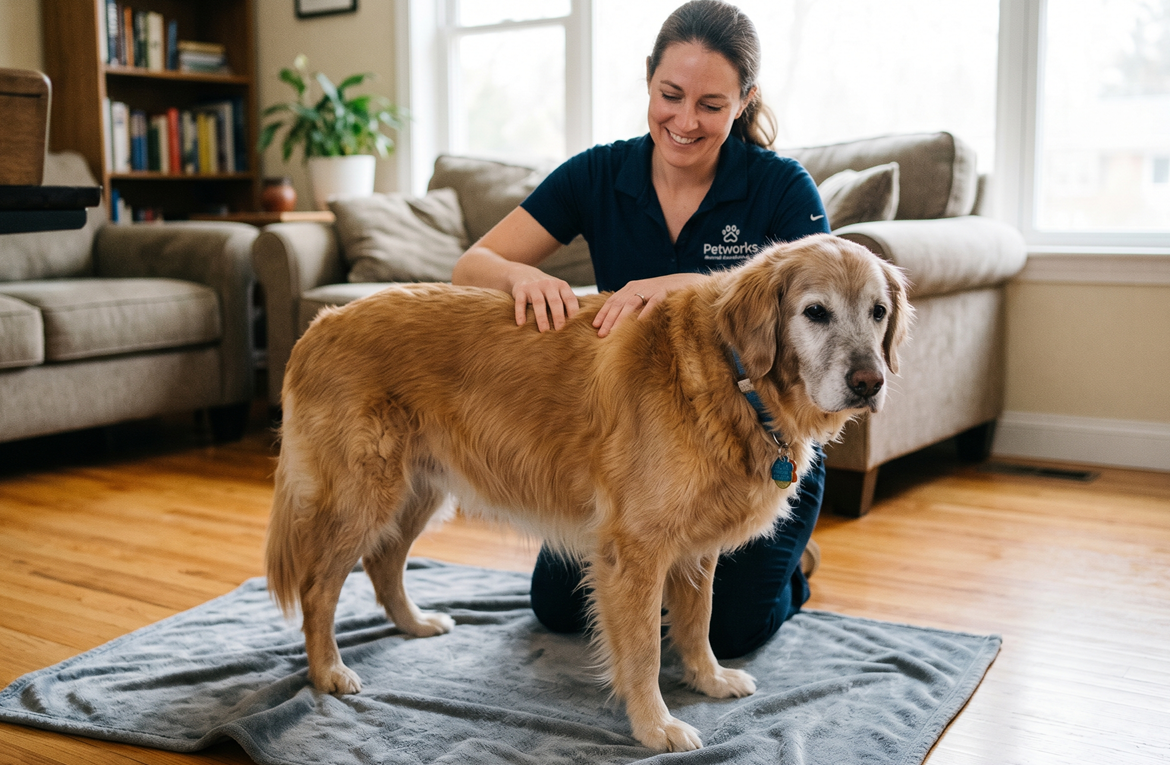
As our dogs enter their golden years, we observe senior dog mobility issues, and often expect them to “slow down.” We watch them struggle to get off the rug or hesitate at the bottom of the stairs, and we sigh, thinking, “Well, they’re just getting old.” But what if it isn’t just “old age”? In many cases, what looks like inevitable aging is actually a build-up of spinal misalignment and joint restriction. When a dog’s spine isn’t moving correctly, it creates a “kink in the hose” for their nervous system, leading to stiffness, muscle wasting, and hidden pain. Is your dog truly “slowing down,” or is their back holding them back? Use this 5-point mobility audit to find out.
1. The “Scuff” Test (Listen to the Gait)
One of the earliest signs of spinal issues isn’t a limp—it’s a sound.
-
The Sign: Listen closely when your dog walks on pavement or hardwood. Do you hear the faint scritch-scritch of their nails dragging?
-
Why it matters: Dragging paws (knuckling) often indicates that the nerves in the spine aren’t communicating perfectly with the legs. A chiropractor helps “reset” these pathways to improve coordination.
2. The “Staircase Hesitation”
Does your dog stand at the bottom of the stairs and look up at you, waiting to be carried? Or do they take a long pause before jumping into the car?
-
The Sign: Reluctance to perform vertical movements they once did with ease.
-
Why it matters: Jumping and climbing require a specific rotation in the pelvis and flexibility in the lower back. If those joints are “locked,” the movement feels impossible or painful.
3. The “Bunny Hop”
Watch your dog from behind while they trot or run in the yard.
-
The Sign: Instead of a fluid, alternating stride, do they move both back legs together in a “bunny hop” motion?
-
Why it matters: This is a classic “compensatory” move. By hopping, the dog is trying to avoid rotating their hips or spine, which suggests stiffness or misalignment in the lumbar region.

Are you finding this article useful? Would you like 100% free access to more articles like these, and free access to over 5,000 vetted pet care service professionals throughout the United States? Sign up here for a free PetWorks account, and we’ll email you a 10% discount code, good towards your first pet care services booking on PetWorks!
4. The “Puppy Slump” (Abnormal Sitting)
Healthy dogs usually sit “square,” with their legs tucked neatly under their hips.
-
The Sign: Does your senior dog slump their legs to one side (the “lazy sit”)? Do they look lopsided or struggle to keep their back straight while sitting?
-
Why it matters: A crooked sit is often a sign that sitting squarely puts too much pressure on a misaligned vertebrae or a sore hip.
5. The “Touch Test”
Gently run your hands down your dog’s back, starting from the neck and moving toward the tail.
-
The Sign: Does the skin “twitch” or ripple? Does your dog dip their back away from your hand, or look around at you suddenly?
-
Why it matters: This is called “hyperesthesia.” It means the nerves in that area are over-stimulated due to inflammation or a spinal subluxation (a joint that is out of place).
The Verdict: How Did Your Dog Score With Senior Dog Mobility?
If your dog failed two or more of these tests, their “slowing down” might be treatable. Canine Chiropractic care for senior dogs isn’t about “cracking backs”; it’s a gentle, non-invasive way to restore motion to the joints and take the pressure off the nervous system.
Many pet parents report that after just a few adjustments, their senior dogs seem “lighter,” more engaged, and—most importantly—back to their old selves.
📍 Ready to help your dog regain their mobility? Don’t let your pup struggle through their golden years. You can find a vetted, certified Dog Chiropractor Near You to perform a professional evaluation and get your dog moving comfortably again.
Frequently Asked Questions about Senior Dog Mobility and Canine Chiropractic Care
Are certified dog chiropractic services safe for senior dogs with arthritis? Yes. In fact, they are highly recommended. While it doesn’t “cure” arthritis, dog chiropractic care improves the biomechanics of the joints around the arthritic areas, reducing the “wear and tear” and alleviating compensatory pain.
How many sessions will my senior dog need? Every dog is different. Some seniors show immediate improvement after one visit, while others with chronic issues may need a “loading phase” of 3-4 weekly sessions followed by monthly maintenance.
Does it replace my veterinary care? No. Chiropractic is a complementary therapy that works best alongside traditional medicine. To ensure the highest level of safety, we recommend choosing practitioners certified by the American Veterinary Chiropractic Association (AVCA), which sets the national standard for dually-trained professionals.
Will the adjustment hurt my dog? Most dogs find the adjustments very relaxing. Because the “force” used is very low and specific, you’ll often see dogs lean into the chiropractor or even yawn and stretch afterward as the tension is released.
 In 2021, Dr. Marty Goldstein DVM joined the pet care platform PetWorks as an advisor in its Animal Nutrition care division. Dr Marty Nature’s Blend is on a mission to help your pets live their healthiest lives possible. Dr. Marty’s pet nutrition expertise and guidance has helped PetWorks evolve and become the preeminent animal and pet nutrition consultation service for pet parents in North America.
 In 2022, Blue Buffalo Founder Bill Bishop Jr. joined PetWorks as Senior Advisor in our Animal Nutrition Care Division. Bill brings his extensive expertise in pet food innovation and business leadership. His guidance helps PetWorks enhance our pet nutrition service offerings, helping to ensure that pet parents throughout the world receive trusted, science-backed nutritional support for their dogs, cats, and animals.
About The Author
 PetWorks Co-Founder Kevin Kinyon is a life-long animal lover who works tirelessly to improve the lives of pets and their parents. Human and animal qualities he values most are integrity, humor, and empathy.
Find Dog Chiropractors in Popular Cities: [Austin] | [Sarasota] | [Denver] | [Phoenix] | [Los Angeles]

 petworks tm