
 Adoption and Rescue Options in the United States
 2025 Costs Associated with Owning an Affenpinscher
Affenpinscher Breed Standard
General Appearance: The Affenpinscher is a small, wiry-haired, terrier-like toy dog known for its intelligence and suitability as a house pet. Originating in Germany, its name means “monkey-like terrier,” reflecting both its appearance and playful demeanor. Originally bred to eliminate rodents in kitchens, granaries, and stables, it is also called the “Diablotin Moustachu” in France, meaning “moustached little devil.” The breed’s overall appearance is more significant than any single feature, presenting a neat yet shaggy look. The upper and second thigh lengths are nearly equal, with moderate stifle bend and angulated hocks.
Size, Proportion, and Substance:
The Affenpinscher is a sturdy, compact dog with medium bone, never delicate. The ideal height at the withers ranges from 9½ to 11½ inches. The withers’ height roughly equals the body length from the shoulder point to the buttocks, creating a square appearance, though females may be slightly longer.
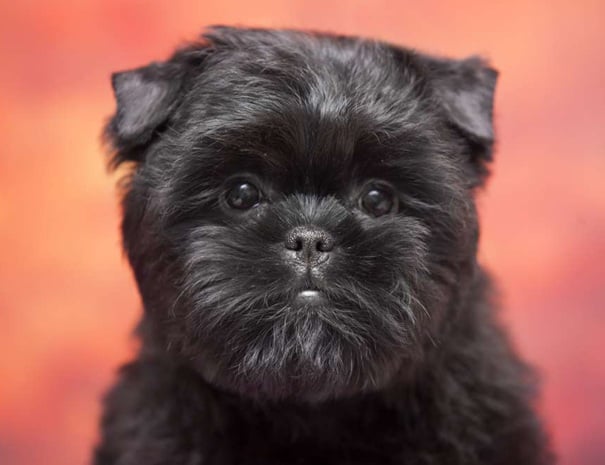
Head: Proportional to the body, the head is confidently carried with a monkey-like expression. The round, dark eyes are medium-sized, not bulging, with black rims. Ears may be cropped and erect or left natural in standing, semi-erect, or dropped positions, provided they maintain symmetry and the characteristic expression. The skull is round and domed but not coarse, with a well-defined stop. The short muzzle tapers slightly to a blunt nose, approximately as long as the distance between the eyes. The nose and lips are black, with a prominent lower lip. The bite is slightly undershot, though a level bite is acceptable. An overshot bite is severely penalized, and a wry mouth is a serious fault. With a closed mouth, neither teeth nor tongue should be visible. The broad lower jaw ensures straight, even lower teeth.
Neck, Topline, and Body:
The neck is short and straight. The topline is straight and level. The chest is moderately broad and deep, with moderately sprung ribs and a slight tuck-up. The short, level back connects to a strong loin, while the croup has a subtle curve. The tail, docked or natural, is set high. A docked tail is typically 1 to 2 inches long and carried erect. The natural tail curves gently over the back when in motion. Tail type is not a major concern.
Forequarters: Moderate front angulation. Shoulders have a moderate layback, with the shoulder blade and upper arm of equal length. Elbows are close to the body. The straight front legs are correctly aligned from any angle. Pasterns are short and straight. Dewclaws are usually removed. Feet are small, round, and compact, with black pads and nails.
Hindquarters: Rear angulation matches the front. The hind legs are straight when viewed from behind and positioned under the body when seen from the side.
Coat:
The Affenpinscher’s coat is dense, rough, and harsh, measuring about an inch long on the shoulders and body, with shorter hair on the rear and tail. The head, neck, chest, stomach, and legs feature longer, softer hair. A mature Affenpinscher has a distinctive mane or cape that blends seamlessly into the back coat at the withers. The longer hair on the head, eyebrows, and beard stands off, framing the face to enhance the breed’s signature monkey-like expression. The ears are clipped short. Minimal grooming is needed to maintain the correct blend of hair lengths for a tidy yet naturally shaggy look.
Color: Acceptable colors include black, gray, silver, red, black and tan, or belge. Black coats may have a rusty tint or a mix of white or silver hairs. Reds can range from brownish red to orangey tan, while belge combines black, brown, and/or white hairs with red. Lighter furnishings are common with certain colors, and some dogs may have black masks. A small white spot on the chest is permissible, but large white patches are undesirable. Color is not a primary concern in judging.
Gait: The Affenpinscher moves with a light, free, balanced, and confident stride, exuding a sense of comic seriousness. When walking, the legs remain parallel when viewed from the front or rear. At a trot, the feet gradually converge toward the midline as speed increases. Any deviation from a sound gait is considered a serious fault.
Temperament:
This breed is lively, alert, and inquisitive, displaying deep loyalty and affection toward its owner and close companions. Generally quiet, the Affenpinscher can become highly animated when threatened, showing fearless determination against any aggressor.
 In 2021, Dr. Marty Goldstein DVM joined the pet care platform Petworks as an advisor in its Animal Nutrition care division. Dr Marty Nature’s Blend is on a mission to help your pets live their healthiest lives possible. Dr. Marty’s pet nutrition expertise and guidance has helped Petworks evolve and become the preeminent animal and pet nutrition consultation service for pet parents in North America.
 In 2022, Blue Buffalo Founder Bill Bishop Jr. joined Petworks as Senior Advisor in our Animal Nutrition Care Division. Bill brings his extensive expertise in pet food innovation and business leadership. His guidance helps Petworks enhance our pet nutrition service offerings, helping to ensure that pet parents throughout the world receive trusted, science-backed nutritional support for their dogs, cats, and animals.
About The Author
 Petworks Co-Founder Kevin Kinyon is a life-long animal lover who works tirelessly to improve the lives of pets and their parents. Human and animal qualities he values most are integrity, humor, and empathy.

 petworks tm







We love Petworks. Affenpinschers are so cute!